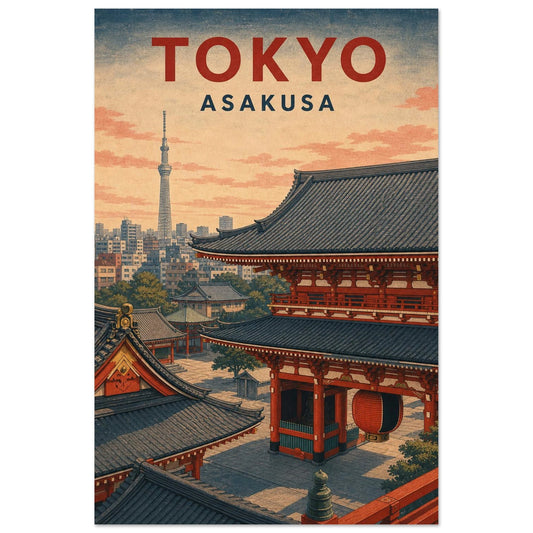
Japanese aesthetics and the arts of Asia pay particular attention to season, gesture, rhythm and empty space. A garden, wave, branch, mountain or architecture can be evoked with restraint, without accumulating cultural signs.
Many visual traditions, beyond stereotyped décor
The vocabulary of this theme brings together prints, mountain landscapes, gardens, cranes, waves, seasonal flowers and wooden architecture. Flat areas of colour, supple lines, textured paper and broad areas of empty space give scenes a rhythm in which emptiness matters as much as the subject. The challenge is to retain this richness while giving every composition a clear hierarchy.
This collection brings together several East Asian visual heritages without reducing each culture to a single symbol or reproducing a protected work. The theme can therefore meet other worlds while retaining a clearly identifiable visual centre of gravity.
Composing with space, gesture and season
A balanced composition brings calm to a bedroom or living room, while a contrast of ink and colour makes a study more assertive. Asymmetry, partial framing and natural materials give the wall precise presence. Respect for the subject depends on coherent elements and an apt atmosphere, far from decorative mixtures that would confuse different traditions. Light and season finally give the décor its true unity.
Before hanging, imagining Japanese and Asian art posters at several distances avoids a choice based on detail alone. Overall silhouette, resting areas and main contrast must still work when you enter the room.
A calm scene suits a bedroom or reading space; a wave or floral motif enlivens the living room. Pairing a landscape with a natural detail creates a more nuanced arrangement than an accumulation of immediately recognisable signs. The right choice is not the one that exactly repeats the room, but the one that brings it a missing rhythm, depth or emotion.