Two portraits, two presences in the room
The Mona Lisa’s gaze sits within a distant landscape. Salvator Mundi, attributed to Leonardo da Vinci, looks out from a dark ground. Compare framing, hand gestures and colours before selecting a size.

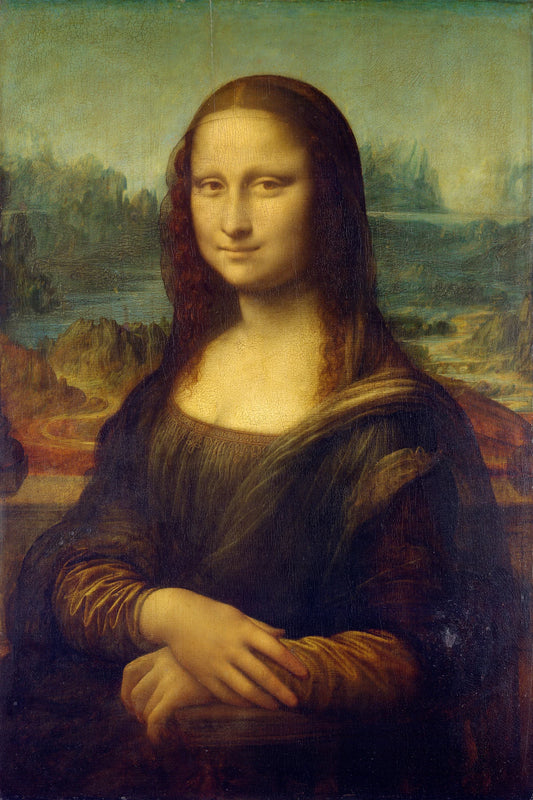
Mona Lisa: a portrait opening onto a landscape
Folded hands occupy the foreground; behind the face, misty greens and blues extend into the landscape. Brown clothing connects the figure to its surroundings. A pale wall defines the silhouette, while restrained furniture keeps attention on the portrait and details.
View this canvas print ↗
Salvator Mundi, attributed to Leonardo: a frontal gaze
The figure faces the viewer, one hand raised and the other supporting a transparent globe. Blue clothing and golden-toned bands stand out against black. In a study or library this vertical composition can become the wall’s focus; brown wood accents echo its palette.
View this canvas print ↗Choosing between a portrait and a frontal figure
The Mona Lisa is recognised by her three-quarter pose, folded hands and deep landscape. Salvator Mundi, attributed to Leonardo da Vinci, uses a frontal pose and a blessing gesture. The difference goes beyond colour: one links a face to distant space; the other concentrates on figure and hands.
Start with the subject you would like to see daily. A famous work can be a personal choice as well as a focal point. Then compare the dark background, silhouette and amount of light in the image.
The Mona Lisa and sfumato: looking at transitions
Gradual transitions between shadow and light soften the Mona Lisa’s facial contours. The distant landscape also becomes more diffuse. This handling is associated with sfumato, a painting technique visible through the reproduction’s printed image.
Viewing distance matters: a larger size gives more space to hands, clothes and landscape. Diffuse light helps compare shadows and highlights. The canvas here is a reproduction; its support differs from that of the original work.
Browns, deep blue and parchment tones at home
Wood, pale stone and plain textiles complement the browns and muted tones of these portraits. An off-white sofa or pale wall separates them from the dark clothing. In a darker interior, check the light so faces and details remain visible.
You need not recreate a Renaissance room. A bookcase, console or contemporary furniture can leave the canvas space. Pick up one or two shades from the image without trying to match every object exactly.
A vertical position for a living room, hallway or study
Both current reproductions have portrait orientation. They can sit above a console, between openings or beside a bookcase. Above a sofa, check the actual selected width rather than estimating it from a room view.
To pair the portraits, measure total canvas width and the gap between them. Compare contrast levels too. Choose similar dimensions or a single work according to space; each reference has its own product page.
The canvas print you receive
The image is reproduced as a print on canvas. Any brushstroke or texture effect visible in the image is part of the printed design.
Each product page details the material, finish and accessories. Check its specifications before choosing your size.
The estimated delivery date appears on each product page. For details, see our shipping policy and our returns policy.
Questions about Leonardo da Vinci canvas prints
Which works are in this collection?
The selection currently offers the Mona Lisa and Salvator Mundi, attributed to Leonardo da Vinci, as canvas reproductions. Each comes in five portrait sizes. The grid shows the references currently available in the collection.
Are La Joconde and Mona Lisa the same painting?
Yes. La Joconde is also known as the Mona Lisa: the portrait with a restrained smile, folded hands and a distant landscape. This product reproduces its image by printing on canvas.
Why is Salvator Mundi described as “attributed to Leonardo da Vinci”?
Specialists debate Leonardo da Vinci’s part in the execution of this Salvator Mundi. “Attributed to” preserves that qualification concerning the represented work. The product here is a printed canvas reproduction.
Are the reproductions hand-painted?
The images are printed on canvas. Modelling effects, light transitions and visible marks do not mean that hand painting or layers of material have been added. Exact specifications appear on each product page.
Which sizes can I choose for a portrait canvas?
The five current sizes are 31 × 46 cm, 41 × 61 cm, 51 × 76 cm, 61 × 91 cm and 81 × 122 cm, width × height. Compare height with the wall section, then width with nearby furniture. Check the chosen reference before ordering.
Explore more canvas reproductions
Compare other artists and compositions in our canvas wall art. Subject, palette and orientation offer useful points of comparison alongside the artist’s name. These two portraits already offer a choice between a face surrounded by landscape and a frontal figure against a dark background.