



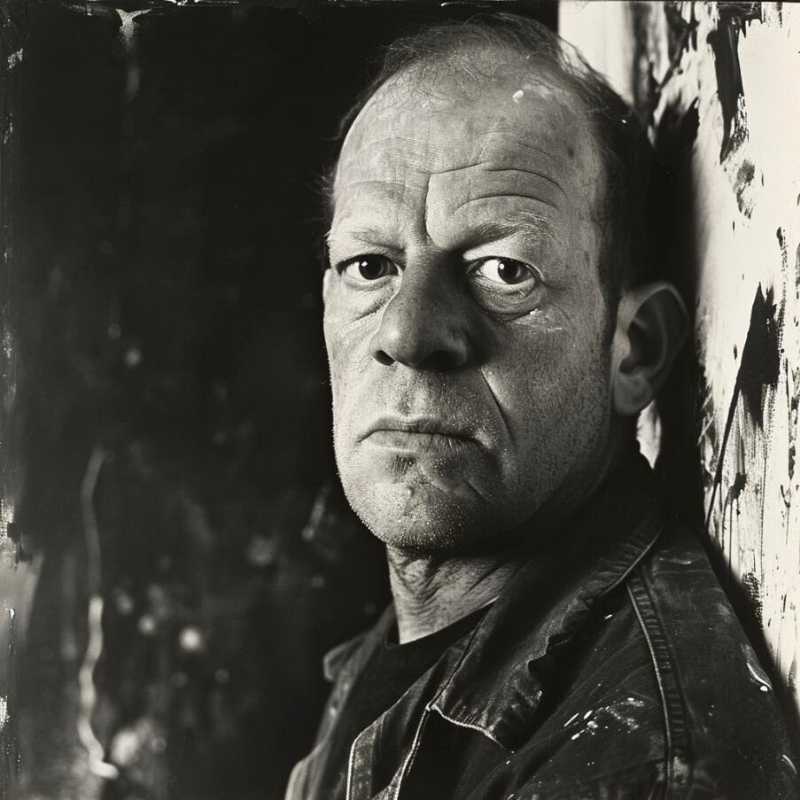
Jackson Pollock: Master of Abstract Expressionism
Ladies and gentlemen, prepare to dive into the explosive universe of Jackson Pollock, the artist who sent the conventions of modern art spinning like a rock'n'roll dancer on acid!
The Pollock Revolution: When Art Goes "Splash"!

Jackson Pollock is nothing less than the earthquake that shook the world of contemporary art and Abstract Expressionism in the 1940s and 1950s. His revolutionary dripping technique, developed in 1947, overturned our perception of what a work of art can be.
As art critic Clement Greenberg, one of Pollock's great champions, so aptly put it: Pollock has broken all distinctions between art and life.
[1] This approach propelled Pollock to the forefront of the New York School, making America the new center of the art world.

Abstract Painting Blue and White – Dripping
Art historian Michael Leja underlines: Pollock succeeded in creating a style of painting that seemed to embody the energy and freedom of post-war America.
[2]
The Alchemist of Action Painting: Birth of a Revolutionary Technique

In the 1940s, Pollock began experimenting with dripping. Inspired by the sand paintings of the Navajo, he laid his canvases flat on the floor and projected paint in a frenzied ballet.
The result? Works of wild energy, such as "Lavender Mist" (1950) and "Blue Poles" (1952). Pollock himself explained his process: When I am in my painting, I'm not aware of what I'm doing. It is only after a sort of "get acquainted" period that I see what I have been about.
[3]
Artist Willem de Kooning, Pollock's contemporary, declared: Jackson broke the ice for all of us.
[4] This simple phrase sums up Pollock's revolutionary impact on his peers and on modern art in general.
The Triumph and the Fall: Glory, Alcohol, and Tragedy

The 1950s marked the apex of Pollock's career. In 1949, Life magazine wondered whether this troublemaker was the greatest painter in the United States.
[5]
But success came at a price. Pollock, who struggled with alcoholism, found himself under intense pressure. His relationship with artist Lee Krasner, whom he married in 1945, was crucial. Art historian Barbara Rose notes: Without Lee, it is doubtful that Pollock could have functioned, let alone painted.
[6]
Tragically, Pollock died in a car accident in 1956, at just 44 years old. But his influence on contemporary art endures.
The Legacy of a Revolutionary: Pollock, the Man Who Changed Art
Pollock's impact on modern painting is immeasurable. Artists like Helen Frankenthaler and Morris Louis were directly influenced by his technique. Even later movements such as Pop Art owe a great deal to the liberation of the pictorial gesture initiated by Pollock.
Today, his works are national treasures. "Blue Poles," for example, was acquired by the National Gallery of Australia in 1973 for two million Australian dollars. In 2016, its value was estimated at more than $350 million, according to gallery director Gerard Vaughan. [7]

A Legacy That Continues to Make Waves
Jackson Pollock, with his abstract canvases, shook the art world like no one before him, reminding us that creativity knows no limits. His work opened dialogues with other forms of Abstract Expressionism such as Mark Rothko and Barnett Newman, influencing artists such as Willem de Kooning, Franz Kline, and Cy Twombly. His influence continues to be felt in contemporary art, proof that his paint splashes have left an indelible mark on the history of art.
So the next time you see an abstract painting that makes you raise an eyebrow, remember our friend Jack. And who knows? Perhaps you too will feel like trying your hand at dripping!
References
- Greenberg, C. (1948). "The Crisis of the Easel Picture." Partisan Review.
- Leja, M. (1993). "Reframing Abstract Expressionism: Subjectivity and Painting in the 1940s." Yale University Press.
- Pollock, J. (1947–48). "My Painting." Possibilities 1.
- Karmel, P. (1999). "Jackson Pollock: Interviews, Articles, and Reviews." The Museum of Modern Art.
- Time Magazine. (1949, August 8). "Jackson Pollock: Is he the greatest living painter in the United States?"
- Rose, B. (1983). "Lee Krasner: A Retrospective." The Museum of Modern Art.
- Snowdon, K. (2016, July 7). "Jackson Pollock's Blue Poles Now Worth $350 Million, Art Expert Says." Huffington Post Australia.