


Art Nouveau: Origins, Artists and Design
Imagine a city where a metro entrance unfurls like a plant, ironwork traces a restless curve and an everyday vase is designed with the care of a sculpture. This is the world of Art Nouveau: an international movement that sought a distinctly modern visual language at the end of the nineteenth century.

Art Nouveau: an aesthetic revolution at the turn of the century

Art Nouveau emerged in the early 1890s and reached its height around 1900. Its vocabulary is broader than flowers alone: asymmetry, elongated silhouettes, organic structures, unusual geometry and the famous “whiplash” line all belong to the style. Brussels, Paris, Vienna, Barcelona, Glasgow and Nancy developed recognisable local versions rather than one uniform formula. The names themselves reveal this diversity: Jugendstil in Germany, Sezessionstil in Vienna and Modernisme in Catalonia. Some versions are luxuriantly botanical; others use restrained grids and sharp geometry. What connects them is the ambition to break with routine historical imitation.
Its most ambitious idea was the unity of the arts. Architecture, furniture, glass, jewellery, posters and domestic objects could be conceived as parts of one coherent environment. That approach challenged the hierarchy separating fine art from applied art and made design central to modern daily life. In Victor Horta’s interiors, for example, the curve of an iron stair rail continues through mosaic, painted wall and furniture. The value lies not in adding ornament everywhere, but in making every scale of the project feel related.
 Gustav Klimt Paintings - Canvases and Reproductions
The historical setting: modern life, industry and craft
The movement grew amid rapid urbanisation, new manufacturing methods and lively debate about the value of craftsmanship. It inherited a taste for expressive freedom from Romantic art, while responding directly to modern streets, advertising and new materials. Designers did not simply reject industry: many searched for a better relationship between structure, ornament, skilled making and serial production. The Arts and Crafts movement encouraged respect for material and workmanship, while Japanese prints offered asymmetrical layouts, flat colour and cropped forms. Electric lighting, large-format lithography and new uses of iron and glass gave artists additional fields in which to experiment.
Art Nouveau and Art Deco are distinct, but the relationship is not a clean break. Art Deco later adopted and stylised parts of the earlier movement’s decorative vocabulary, while favouring sharper geometry, luxurious materials and imagery shaped by the machine age.
The makers who shaped Art Nouveau

Art Nouveau was built by artists, architects and craftspeople who moved easily between disciplines. Five names offer a useful route into its geographic and material diversity:
- Hector Guimard: his Paris Métro entrances turn cast iron and lettering into a unified piece of urban design. Castel Béranger shows the same attention extending from façade to interior detail.
- Émile Gallé: the Nancy glassmaker and designer studied plants closely and translated stems, leaves and insects into layered glass, furniture and marquetry. Nature is both subject and organising principle in his work.
- Alphonse Mucha: his posters for Sarah Bernhardt helped make the style a public phenomenon. Narrow formats, ornamental halos, flowing hair and carefully integrated lettering gave advertising a new visual authority.
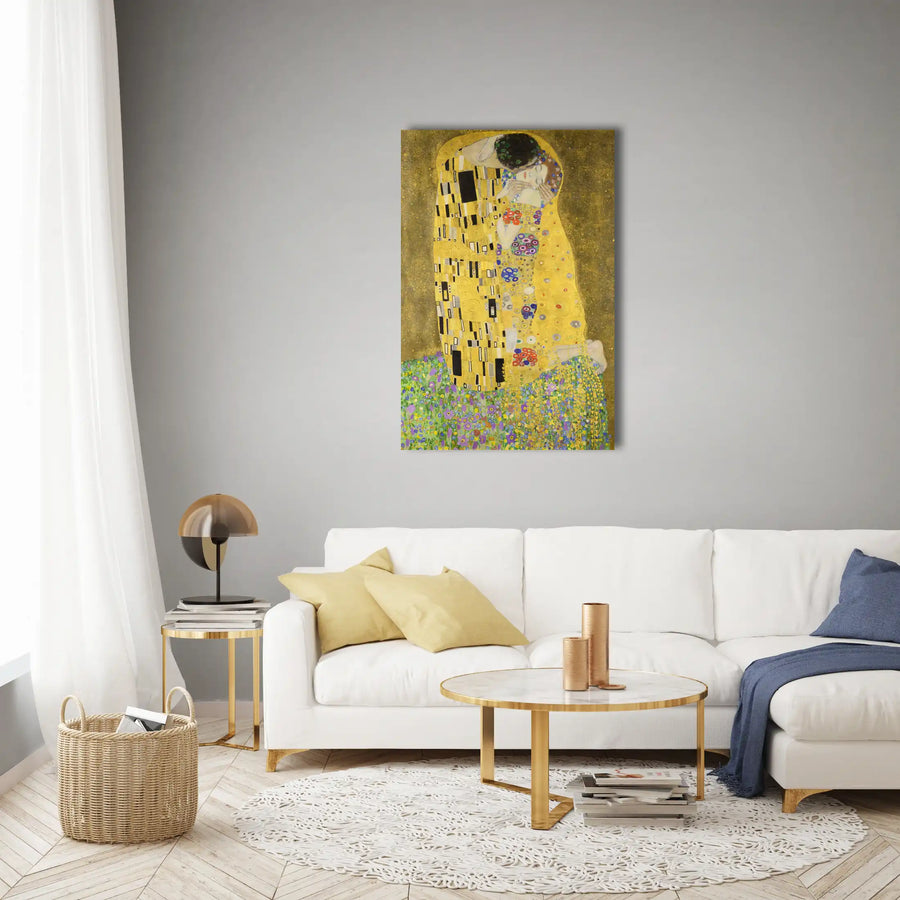
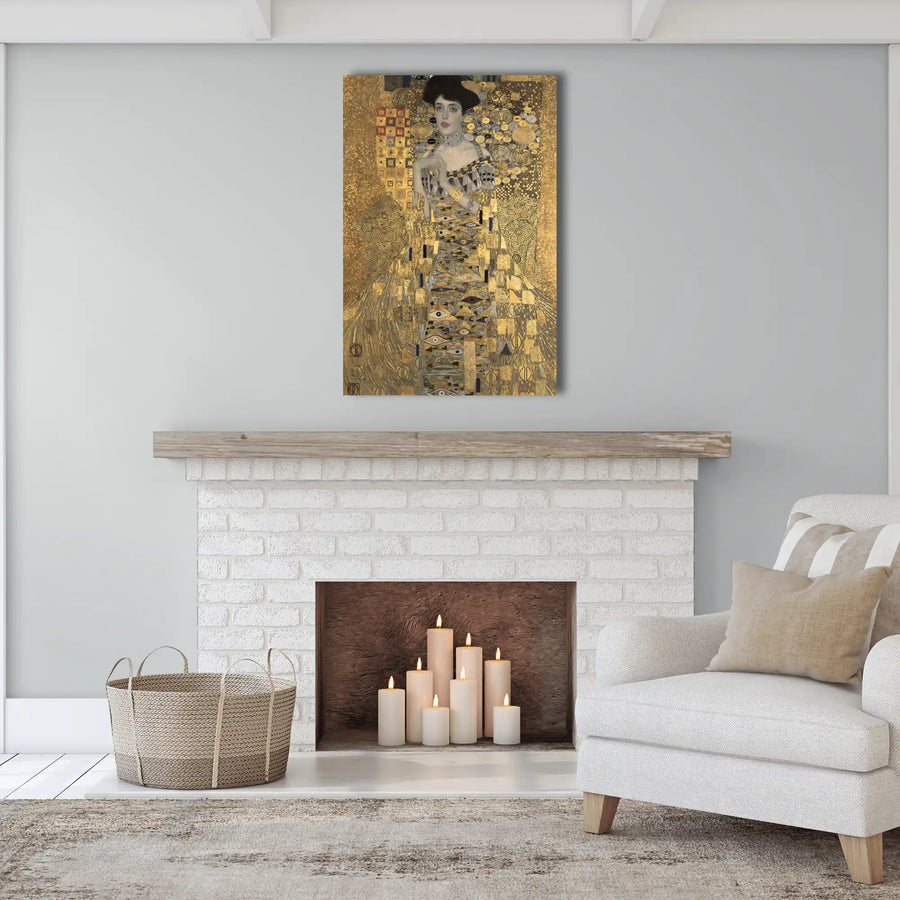
- Gustav Klimt: as a leading figure of the Vienna Secession, he combined figures, pattern and gold with a more geometric version of the new style. Vienna’s contribution reminds us that Art Nouveau was not always dominated by flowing plant forms.
- Antoni Gaudí: in Barcelona, architecture, structure, mosaic and crafted detail become inseparable. Park Güell and Casa Batlló show how Catalan Modernisme developed its own language within the wider international movement.
One style, many disciplines

The movement is easiest to understand when its disciplines are viewed together. A line developed for a poster might reappear in a chair, a stair rail or a jewel; structure and decoration were meant to speak the same language.
- Architecture: Victor Horta’s Hôtel Tassel and Guimard’s Paris buildings treat stairs, handles, ironwork and glazing as elements of a single composition. Art Nouveau architecture is therefore best read in detail as well as from the street.
- Decorative arts: furniture by Louis Majorelle and glass by Gallé demonstrate how the shape of an object, its material and its ornament can reinforce one another. The result is expressive without treating decoration as an afterthought.
- Jewellery: René Lalique expanded the jeweller’s palette with enamel, glass and horn as well as precious materials. Insects, orchids and female profiles become small sculptural structures rather than conventional floral embellishment.
- Graphic arts: Mucha, Aubrey Beardsley and other illustrators used silhouette, flat colour, border and lettering to control the entire printed page. Posters carried the new style directly into the modern city.
What Art Nouveau changed
Art Nouveau flourished for a relatively short period, from the early 1890s to the years before the First World War. Its legacy is nevertheless substantial: it helped establish design as a field in which architecture, graphics, objects and interiors could be considered as a connected whole. The style did not disappear on a single date. Its most elaborate forms lost favour, while geometric strands associated with Vienna and Glasgow fed into later modern design. Museums now preserve both celebrated masterpieces and ordinary objects that show how widely the visual language circulated.
- It weakened the old separation between “major” and applied arts. The idea of a total environment influenced later debates about design, even when later movements rejected Art Nouveau ornament.
- Its organic lines and interest in natural structures remained available to later designers and artists. Surrealist biomorphism is one example of a later language that drew selectively on this inheritance.
- It made the relationship between beauty and use a central design question. Art Nouveau objects can be highly decorative, but their strongest examples also reveal close attention to material and function.
- The Bauhaus, founded in 1919, pursued a very different visual economy. The comparison is useful because both movements reconsidered the relationship between art, craft and daily life, despite reaching markedly different formal solutions.
How to recognise and use Art Nouveau today
Today, the style remains visible in protected buildings, museum collections and contemporary interiors. The most convincing way to draw on it is to understand its principles—rhythm, material, line and unity—rather than covering a room with unrelated floral motifs. A Mucha poster creates a very different atmosphere from a Mackintosh chair or a Lalique-inspired glass object. Before choosing a piece, look at the dominant line, the density of the pattern and the balance between figure and background. These qualities determine how easily it can share a room with existing furniture.
- Start with surviving architecture. Brussels, Nancy, Paris, Vienna and Barcelona each reveal how local materials and traditions altered the international style.
- For an interior, choose one organising gesture: a sinuous frame, a botanical print, a stained-glass lamp or a piece of curved furniture. Repetition of line and colour creates coherence more effectively than mixing every Art Nouveau motif at once.
- When buying an original period object, examine attribution, materials, condition and restoration history. Market price alone does not establish quality, authenticity or suitability for a particular room.
More than floral decoration

Art Nouveau was not a single decorative recipe. It was an international attempt to create a modern style by joining art, craft and everyday use. Its finest works balance exuberant surfaces with careful construction: the curve follows a staircase, a plant form clarifies the shape of a vase, and lettering belongs to the composition of a poster. This is why close looking matters. A reproduction that retains the original proportions, tonal transitions and border usually conveys the work more faithfully than a heavily cropped motif. For architecture and objects, craftsmanship, condition and restoration also shape what we see today.
That balance explains why the movement still feels alive. It invites us to look beyond ornament and ask how an object, image or room has been organised. In a contemporary interior, one strong Art Nouveau reference usually has more impact than a crowded collection of motifs.
Where to explore Art Nouveau
- The Musée de l’École de Nancy brings together Gallé, Majorelle and the city’s wider community of designers and craftspeople.
- In Brussels, the Horta Museum preserves Victor Horta’s house and studio and gives a direct sense of his approach to space, light and integrated detail.
- Prague offers a focused introduction to Mucha’s posters and decorative language; major museum collections elsewhere also help place his commercial work in a broader graphic context.
- In Barcelona, Casa Batlló, Casa Milà and Park Güell allow visitors to compare Gaudí’s treatment of structure, surface, colour and crafted elements.
Recommended books
- Fahr-Becker, Gabriele. "Art Nouveau." H.F. Ullmann, 2015. An essential reference for understanding Art Nouveau in all its geographical and artistic diversity.
- Greenhalgh, Paul. "Art Nouveau 1890–1914." La Renaissance du Livre, 2002. An in-depth analysis of the social and cultural context in which Art Nouveau was born.
- Sembach, Klaus-Jürgen. "Art Nouveau: The Utopia of Reconciliation." Taschen, 2013. A richly illustrated work exploring the different expressions of Art Nouveau across Europe.
To continue from Art Nouveau to the sharper geometry of the following decades, explore our Art Deco wall art collection.
Further reading
- Silverman, Debora L. "Art Nouveau in Fin-de-Siècle France: Politics, Psychology, and Style." University of California Press, 1992. A fascinating study of the political and psychological implications of Art Nouveau in France.
- Escritt, Stephen. "Art Nouveau." Phaidon Press, 2000. A comprehensive overview of the movement, from its origins to its influence on contemporary art.
Art Nouveau rewards slow looking. Follow the movement of a line, compare how different cities translated the style, and notice how materials affect the result. This attentive approach makes it easier to choose a print or decorative object for its composition—not simply for a fashionable label.