



Contemporary Artists: How to Read Art Today
A banana taped to a wall, a room filled with mirrors, a field of black paint that changes with the light: contemporary art can be immediate, puzzling or both at once. The useful question is not “Do I understand it instantly?” but “What is this work asking me to notice?”
This guide introduces the ideas, artists, places and media that shape art today. It also shows how to look slowly, compare evidence and choose a contemporary wall artwork for your own space without confusing decoration, historical importance and financial speculation.
Understanding Contemporary Art: Beyond Received Wisdom

Before immersing ourselves in the world of contemporary artists, let's untangle a few conceptual knots that often stand in the way of understanding.
What Is Contemporary Art? Definition and Origins
Contemporary art generally means art made in the present and recent past. The boundary is not fixed: some institutions begin after 1945, while MoMA’s current glossary uses roughly 1980 to today. Dates are therefore orientation points, not a universal rule.
What matters is the field’s openness. Contemporary artists may work with painting, installation, performance, film, sound, code or living materials. Many examine current social and political questions; others test how art is displayed, circulated or defined.
A useful way to compare periods is to read our guide to modern art, then ask what changed when concept, context and audience participation became as important as a work’s physical form.
Contemporary Art vs. Modern Art: Untangling the Boundaries
Confusion between modern art and contemporary art is common and understandable. To simplify: modern art (approximately 1860 to 1970) was revolutionary in form but often retained the idea that art should be the expression of a subjective vision of the world. Movements such as Impressionism, Cubism, and Futurism overturned aesthetic codes while maintaining a certain autonomy of art.
Contemporary art, by contrast, breaks with this tradition: it questions the very boundaries of art, integrates conceptual, political, and social dimensions, and uses absolutely every possible and imaginable medium. A contemporary artist can work just as well with oil paint as with refuse, pixels, or their own body.
| Characteristics | Modern Art | Contemporary Art |
|---|---|---|
| Period | ~1860–1970 | Commonly the late 20th century to today; boundaries vary |
| Approach | Formal innovation, break with tradition | Conceptual questioning, dissolution of boundaries |
| Relationship to the market | Often marginal, then integrated | Complex relationship, sometimes critical, sometimes symbiotic |
| Media | Primarily traditional (painting, sculpture) | All possible media (installations, video, performance, digital...) |
The Circle of International Contemporary Artists

Now that we have laid the conceptual foundations, let's dive into the deep end and meet some of the major figures who have shaped international contemporary art.
The Icons Who Revolutionized Contemporary Art
These artists redefined what art could be, each in their own way:
- Damien Hirst — The British enfant terrible who shook the art world with his animals preserved in formaldehyde and his provocative works on death and consumption. His piece "For the Love of God" (a human skull covered in diamonds) remains one of the most striking symbols of the excess of the contemporary art market.
- Yayoi Kusama — The Japanese artist with her obsessive polka dots, whose immersive installations transform our perception of space. Her Infinity Mirror Rooms use repetition, reflection and controlled viewpoints to make the viewer part of the work.
- Ai Weiwei — The Chinese artist-activist who uses his art as a political weapon to denounce human rights violations and censorship. His installation "Sunflower Seeds" at the Tate Modern — comprising millions of hand-crafted porcelain sunflower seeds — brilliantly interrogated the notions of mass production, craftsmanship, and individuality in contemporary China.
- Takashi Murakami — The Japanese Pop wizard who created a bridge between otaku culture, classical Japanese art, and the Western art market. His concept of "Superflat" is not merely a recognizable visual style; it is a genuine cultural theory about the flattening of hierarchies between high and low culture.
- Anish Kapoor — The Anglo-Indian sculptor known for his monumental installations and his explorations of space, color, and materials. His work "Cloud Gate" (affectionately nicknamed "The Bean") in Chicago has become a global urban icon, transforming public space into a shared artistic experience.
Reading note: begin with what is materially present, then examine the title, date, site and social context. Interpretation becomes stronger when it is tied to visible evidence.
Art Virtuoso editorial method
Emerging Artists: The New Voices Shaping Tomorrow
Beyond the established figures, a new generation of contemporary artists is redefining the contours of current creation:
- Njideka Akunyili Crosby — This Nigerian-American artist creates dense, multi-layered works that explore transcultural identities through a unique technique combining painting, collage, and photographic transfers.
- Avery Singer — Using 3D modeling and acrylic paint, Singer produces works that appear digital but are in reality painted by hand, blurring the boundaries between virtual and tangible in a profoundly contemporary manner.
- Arthur Jafa — Filmmaker and artist Arthur Jafa builds densely edited moving-image works around Black life, music, violence and representation. Love Is the Message, the Message Is Death is a key example of how montage can carry both historical argument and emotional force.
French Contemporary Art: Between Tradition and Innovation

France, the historic cradle of so many artistic revolutions, continues to play a crucial role in the landscape of contemporary art.
The French Masters of Contemporary Art
Several French artists have gained international recognition while developing a singular approach:
- Pierre Soulages — The master of "outrenoir" (beyond black), who devoted the greater part of his long career to exploring the infinite possibilities of black, creating works in which light reflects differently depending on the angle and texture of the paint. His recent passing in 2022, at the age of 102, marked the end of an era for French art.
- Annette Messager — A protean artist who explored questions of gender, identity, and memory through installations combining found objects, photographs, and textiles. Her simultaneously intimate and universal approach makes her one of the most original voices in French contemporary art.
- Daniel Buren — Known for his in situ interventions and his celebrated 8.7 cm vertical stripes, Buren transformed our perception of public and institutional space. His columns in the courtyard of the Palais-Royal in Paris have become a symbol of the way contemporary art can enter into dialogue with historical heritage.
- Philippe Parreno — A conceptual artist who explores notions of time, memory, and experience through complex immersive installations. His capacity to radically transform entire spaces makes him one of the most inventive French artists of his generation.
- Christian Boltanski — This major artist, who passed away in 2021, devoted his work to memory, absence, and the fragility of human existence. His installations using clothing, photographs, and personal objects create moving monuments to collective and individual memory.
This list, of course, is only a glimpse. Creators such as Niki de Saint Phalle or the Nouveaux Réalistes would also merit their place in this pantheon of French contemporary art.
The New Generation of French Artists to Watch
The French contemporary scene is particularly dynamic, with artists who reinvent tradition while engaging with global issues:
- Camille Henrot — Her encyclopedic work crosses media (sculpture, drawing, video) to explore the way we construct and organize knowledge in the digital age.
- Neïl Beloufa — His installations combining video, sculpture, and architecture interrogate our relationship to power, technology, and media representations with biting irony.
- Laure Prouvost — Although based in Belgium, this French artist deploys an immersive and poetic universe in which words, objects, and images respond to one another in a unique sensory ballet.
Where to Immerse Yourself in Contemporary Art?

Now that you know the players on the contemporary scene better, let's discover the places where their works come to life.
Temples of Contemporary Art: Essential Museums
These institutions are privileged entry points for discovering contemporary art:
- Centre Pompidou (Paris) — Its collection remains a major reference for modern and contemporary art. Because the Paris building is undergoing a long renovation programme, check the institution’s current off-site exhibitions and access information before planning a visit.
- Palais de Tokyo (Paris) — More than a museum, a genuine laboratory of contemporary creation. Its vast spaces host experimental exhibitions and performances that constantly push the limits of art.
- CAPC (Bordeaux) — Installed in a former maritime warehouse, this museum offers an adventurous programme in an impressive architectural setting.
- Collection Lambert (Avignon) — This contemporary art museum born from the donation of gallerist Yvon Lambert presents an exceptional collection in the setting of an 18th-century townhouse.
- MUDAM (Luxembourg) — Just across the border, this museum designed by I.M. Pei offers an international vision of contemporary art in an exceptional architectural setting.
Internationally, institutions such as the Tate Modern (London), MoMA (New York), the Guggenheim Bilbao, or M+ (Hong Kong) are absolute reference points for understanding contemporary artistic movements.
Contemporary Art Galleries: Settings for Current Creation
Galleries play a crucial role in the discovery and promotion of contemporary artists:
- Perrotin (Paris, New York, Hong Kong...) — Emmanuel Perrotin built an international empire by representing artists such as Takashi Murakami, Jean-Michel Othoniel, and Sophie Calle.
- Kamel Mennour (Paris) — This gallery represents both established artists such as Anish Kapoor and emerging talents.
- Air de Paris (Paris) — A pioneer in the promotion of conceptual and engaged artists since 1990.
Don't hesitate to push open gallery doors, even if you have no intention of buying. Most are free and offer a more intimate experience with the works than large museums.
Artistic Gatherings: Fairs and Events Not to Be Missed
To take the pulse of contemporary creation, these events are essential:
- Art Basel Paris — The Paris fair now occupies the Grand Palais. Its 2026 edition brings together more than 200 exhibitors and includes sectors for established galleries, emerging programmes and focused curatorial proposals.
- Art Paris (Paris) — This spring fair brings together modern and contemporary art and is useful for comparing galleries, artists and price levels in one visit.
- Venice Biennale (Italy) — The 2026 Art Biennale, In Minor Keys, runs across the Giardini, Arsenale and other Venetian venues from May to November. Its national pavilions and international exhibition make comparison part of the visit.
- Nuit Blanche (Paris and other cities) — This annual event transforms urban space into a giant art gallery for one night.
Contemporary Art in All Its Forms
One of the fundamental characteristics of contemporary art is its refusal of boundaries between disciplines and media.
From Canvas to Screen: The Many Faces of Contemporary Art
Contemporary art expresses itself through a multitude of forms:
- Contemporary painting — Far from being dead, as has often been proclaimed, it constantly reinvents itself. Painters such as Peter Doig, Elizabeth Peyton, or Gerhard Richter demonstrate the enduring vitality of this age-old medium.
- Installation — These environmental works transform space and often engage all our senses. Think of Ann Veronica Janssens's pools of liquid color or James Turrell's light chambers.
- Performance — Art in which the artist's body becomes the medium. Marina Abramović is its most celebrated exponent, with performances that are often physically and emotionally challenging.
- Video art — From pioneers such as Nam June Paik to current creators like Pipilotti Rist, the moving image has become a full-fledged artistic medium.
- Sound art — Artists such as Christine Sun Kim explore sound as sculptural and conceptual material.

In an interior, contemporary painting can be approached through colour, rhythm and scale before interpretation. This contemporary landscape wall art, for example, combines a recognisable horizon with simplified forms, making it easier to connect the scene to the room without reducing it to a literal view.

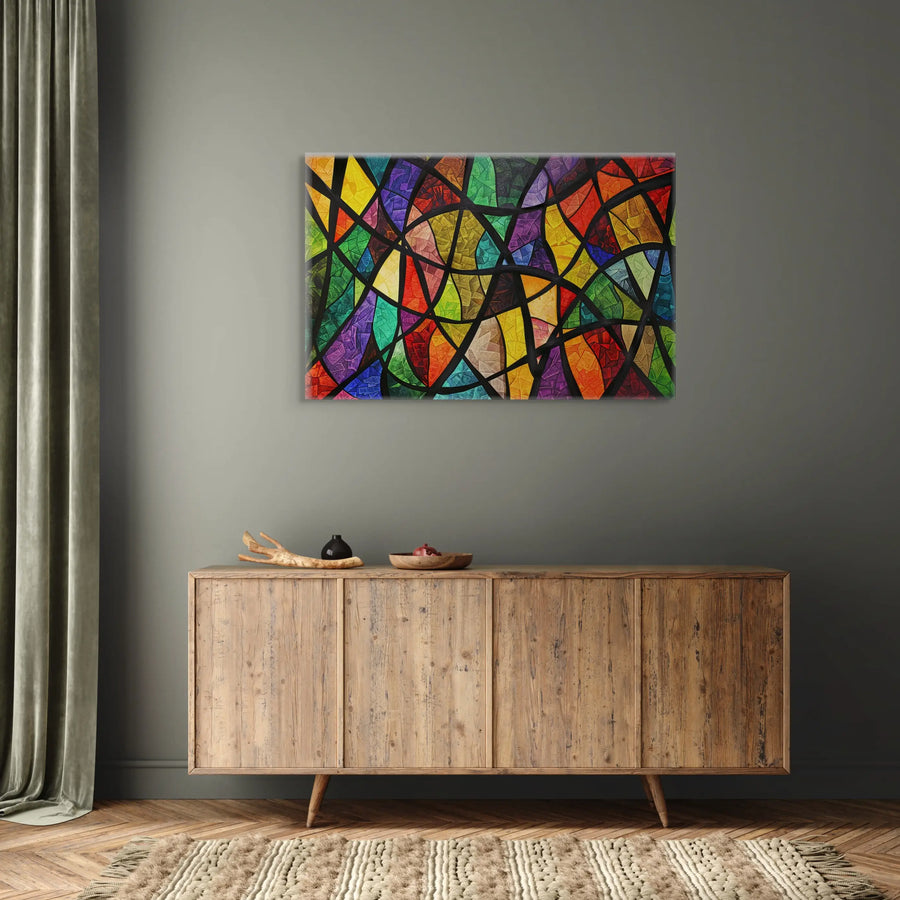
The same visual vocabulary can move between fine-art references and decoration. Explore the contemporary wall art collection or compare how this stained-glass inspired abstract uses divided colour fields to structure a wall.
When Art Takes Hold of New Technologies
The emergence of new technologies has opened unprecedented territories for contemporary artists:
- Digital art — Works created with digital tools, from pixel art to complex 3D modeling.
- Generative art — Works created by algorithms, where the artist defines rules that the computer executes, often producing unpredictable results.
- Virtual and augmented reality — Artists such as Jakob Kudsk Steensen create immersive worlds that question our relationship to the real.
- Bio Art — At the frontier between art and science, artists such as Eduardo Kac work with living biological materials.
- Blockchain-based editions — Tokens can record ownership or provenance for a digital edition, but they do not automatically prove artistic quality, copyright ownership or investment value. Read the work, contract and platform separately.
Collecting Contemporary Art: Passion and Investment
Collecting contemporary art can deepen your relationship with artists and images. Treat financial return as uncertain: condition, provenance, edition size, demand and resale costs all matter, and no guide can guarantee appreciation.
Starting a Collection: Advice for Art Lovers
A few starting points for acquiring contemporary art:
- Educate your eye — Before buying, visit exhibitions, browse catalogues, follow artists on Instagram. Develop your aesthetic sensitivity and identify what truly moves you.
- Start modestly — Limited editions, prints, or photographs are often more accessible than unique pieces, while still allowing you to acquire works by recognized artists.
- Explore emerging fairs — Events such as "Paréidolie" in Marseille or "Drawing Now" in Paris allow you to discover promising artists at more affordable prices.
- Buy with your heart — The art you acquire must above all please you, move you, make you think. Investment should only be a secondary consideration.

If your starting point is the room rather than the market, focus on proportion, viewing distance and palette. This contemporary abstract Op Art design creates a strong focal point; the decisive question is whether its movement supports the atmosphere you want to live with.
The Contemporary Art Market: Between Passion and Investment
The contemporary art market is a complex ecosystem:
- It is characterized by high volatility and a concentration of value in a small number of "star" artists.
- Auction houses such as Christie's and Sotheby's play an increasingly important role, with record sales that regularly make the headlines.
- The emergence of online platforms has democratized access to the market, allowing new collectors to enter the scene.
Collector’s rule: buy the work you want to keep, document what you are buying, and regard any future resale value as uncertain.
Practical buying note
Contemporary Art: A Personal Adventure
At the end of this journey through the universe of contemporary artists, I would like to share a personal conviction: the art of today is not an enigma reserved for an elite, but an open invitation to all.
Contemporary art can sometimes seem hermetic or provocative, but it is above all a reflection of our world — its contradictions, its upheavals, and its hopes. It invites us to question our certainties, to sharpen our gaze, and to enrich our experience of the real.
So hesitate no longer: push open a gallery door, stroll through a contemporary art museum, strike up a conversation with an artist at a vernissage. Allow yourself to be surprised, moved, sometimes unsettled. For it is precisely in this friction with the unknown that the magic of art resides: its capacity to broaden our vision of the world and of ourselves.
And you — which contemporary artist has left the greatest impression on you? Which work made you see the world differently? Share your discoveries and your personal favorites in the comments — living art feeds on our exchanges and our shared perspectives!
Sources and Resources for Further Reading
- MoMA, “Contemporary art” and About the Collection.
- Centre Pompidou, online contemporary collection search.
- Art Basel, Art Basel Paris 2026.
- La Biennale di Venezia, Biennale Arte 2026.
- Anne Cauquelin, L’Art contemporain, PUF; Nathalie Heinich, Le Paradigme de l’art contemporain, Gallimard.