

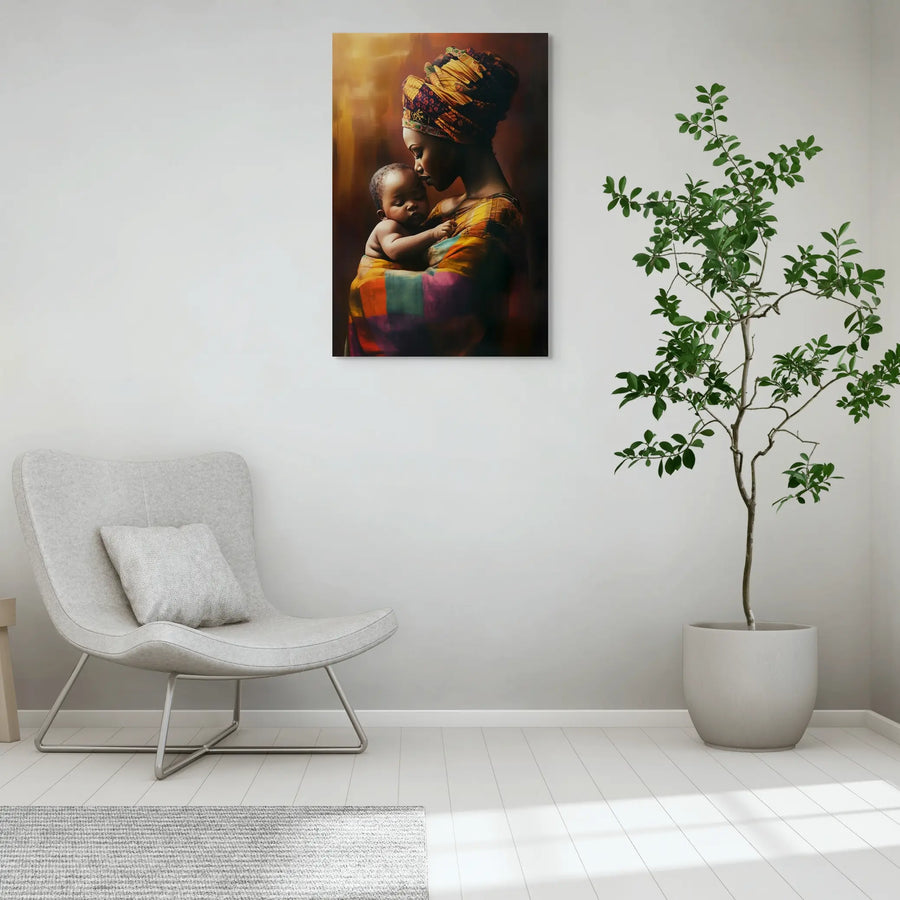


Paintings of Women: Styles, Artists and Display Ideas
Paintings of women are never neutral records of a universal “feminine” ideal. From Renaissance portraits to modern self-portraits and fragmented figures, they reveal changing ideas about identity, beauty, social position, authorship and the gaze. Looking closely means asking both how the image is made and who is allowed to look, speak or act within it.

This guide follows those changes across portraiture, genre painting and modern art, then turns them into practical criteria for choosing wall art. You can also browse our collection of paintings and portraits of women while comparing style, mood, palette and format.
Paintings of Women: Styles and Ways of Looking

Artists have represented women through likeness, allegory, fantasy, social observation and self-definition. These approaches overlap, but separating them helps us distinguish a commissioned portrait from an imagined type, a scene of modern life from a private self-portrait, and a decorative image from an artwork with a specific historical context.
Portraits of Women: From Likeness to Abstraction
The portrait is central to this history, yet “portrait” covers very different intentions. Some works identify a sitter and her social position; others study expression, costume or light; still others deliberately dismantle resemblance. A useful reading begins with pose, gaze, scale, setting and the relationship established with the viewer.
Realistic portraits: Capturing likeness and expression
Likeness and presence: a naturalistic portrait coordinates anatomy, modelling, light and surface to make a person appear present. Fidelity is not photographic neutrality: clothing, gesture, background and cropping are choices that construct status and character.
Vermeer’s Girl with a Pearl Earring is a helpful warning against easy labels. It is held by the Mauritshuis, not the Louvre, and the museum identifies it as a tronie—a study of an imagined character rather than a commissioned portrait. Its intimacy comes from the turn of the head, the parted lips and a few precise effects of light, as the Mauritshuis collection record explains.
Impressionist portraits: Light and color in service of femininity
Impressionist portraits and modern life: looser brushwork and shifting light did not erase identity; they changed how presence could be conveyed. Renoir, Monet, Berthe Morisot and Mary Cassatt placed figures within theatres, gardens and domestic interiors shaped by modern urban life.
Renoir’s La Loge is not simply a luminous society portrait. The Courtauld notes its staged game of looking: the woman becomes visible to the audience while her companion scans another theatre box. Fashion, spectatorship and painterly display are inseparable.
Expressionist portraits: Exploring emotions and the inner world
Expressionist intensity: in Expressionism and later expressive painting, distortion and non-naturalistic colour can make psychological tension more important than flattering likeness. Schiele and Munch use the body as an unstable carrier of desire, fear and vulnerability.
Munch’s Madonna is deliberately ambiguous rather than a single statement about femininity. The curved body, dark surround and red halo can evoke ecstasy, danger, birth and death at once. The image is strongest when those tensions remain open instead of being reduced to a biographical formula.
Abstract portraits: Woman as form and color
Between figure and abstraction: modern painters did not simply abandon the body. They tested how far a face or torso could be reorganised before recognition gave way to colour, line and gesture.
Willem de Kooning’s Woman I belongs to a series begun in 1950. The Museum of Modern Art records both its repeated repainting and the sharply divided reactions it provoked, including readings of the image as objectifying or violent. Its force lies partly in that unresolved tension between figure, gesture, attraction and aggression.

Still Life, Objects and Gender
Objects associated with dress, grooming or domestic work can evoke a person without depicting her. They should not, however, be treated as naturally “feminine”. Their meaning depends on period, ownership, labour and context: a sewing box may register skill or constraint; jewellery may indicate status, exchange or self-fashioning.
Still life therefore offers an indirect route into gender history. The most revealing question is not whether an object looks delicate, but whose work, choices and social world it makes visible—and whose remain outside the frame.
Genre Scenes: Women in Social Space
Genre scenes place women in theatres, cafés, workshops, streets and homes. They can preserve details of clothing and activity, but they also stage roles for viewers. Vermeer’s interiors, Degas’s dancers and Daumier’s workers do not provide a transparent encyclopedia of women’s lives; each filters experience through artistic and social conventions.
Look for agency as well as setting. Does the figure meet the viewer’s gaze, concentrate on work, perform for an audience, or appear unaware of being observed? Those small decisions change the relationship between description, narrative and power.
Women in Art History

A chronological overview shows how the representation of women changes with patronage, training, exhibition systems and access to public life. It also prevents one recurring mistake: treating every female figure as evidence of one timeless idea of womanhood.
The Renaissance: Portrait, Status and Ideal
Renaissance portraits range from idealised mythological figures to closely observed sitters. Profile portraits could mark marriage and lineage, while devotional images assigned women sacred roles. Clothing, jewellery, gaze and inscription often communicate family position as clearly as facial likeness.
These images are social constructions as well as individual representations, but their meanings vary by city, patron and function. The sitter’s pose, the intended destination of the work and the conventions governing her visibility reveal how identity was framed in each setting.
The Baroque: Drama, Body and Agency
Baroque painting intensifies movement, light and bodily presence, but it does not offer a single model of femininity. Rubens’s mythological bodies, Caravaggio’s dramatic narratives and Artemisia Gentileschi’s protagonists address different audiences and demands.
Gentileschi’s biblical heroines are important not because a woman artist was simply “rare”, but because her successful international career complicates that shorthand. The National Gallery of Art places her alongside a much broader history of women artists whose work spans portraiture, history painting, abstraction and sculpture.
Impressionism: Women and Modern Life
Impressionist images move women into recognisably modern settings, yet access to those settings was unequal. Theatre boxes, gardens, railway journeys and domestic rooms disclose class and gender boundaries as well as new leisure. A fashionable scene can therefore be both pleasurable and socially exacting.
Berthe Morisot and Mary Cassatt brought sustained attention to women’s spaces and relationships, but their work should not be reduced to private intimacy. Composition, cropping and brushwork make them central participants in the reinvention of modern painting.
Modern and Contemporary Art: Many Forms of Identity

Twentieth-century art multiplies rather than resolves the image of women. Cubism fragments bodies, Surrealism turns them into contested signs, and abstraction shifts attention toward form and process. Self-portraiture gives artists such as Frida Kahlo another means of controlling how identity is constructed.
Feminist practices from the late 1960s onward challenged the assumptions behind the traditional nude, the hierarchy of mediums and the exclusion of women from institutions. Contemporary artists extend that critique through race, class, sexuality, disability and gender identity.
It is therefore more accurate to speak of many situated experiences than of “the woman” as a fixed category. Training, patronage, exhibition access, class and race shaped which experiences became visible and which artists entered the canon.

A geometric portrait can bring a strong rhythm to a contemporary room. This Cubist portrait of a woman is presented as contemporary decorative wall art, not as a historical Cubist original.
Artists Who Changed the Image of Women

Women Artists: Training, Careers and Recognition
The history of women artists is not a footnote to the history of images of women. Training, academy membership, access to life drawing, commissions and collecting all affected whose work entered museums and textbooks. The barriers were structural, not evidence of absent talent.
In eighteenth-century France, academy membership for women was explicitly restricted; in the nineteenth century, access to life drawing and official competitions remained limited. The Metropolitan Museum of Art and its study of nineteenth-century women artists document those obstacles while also showing women building careers, studios and networks.
Artemisia Gentileschi, Adélaïde Labille-Guiard, Berthe Morisot, Mary Cassatt and Frida Kahlo worked in very different contexts. Cindy Sherman and Jenny Saville later questioned stereotype, scale and the body through photography and painting. Their work belongs in the main narrative, not in a separate list of exceptions.
Canonical Artists and the Politics of Representation
Several canonical artists transformed the visual language through which women were represented. Their formal innovations matter, but so do the conditions in which models were named, idealised, sexualised or silenced. Reading both dimensions avoids turning biography into a parade of “muses”.
Leonardo da Vinci: Mona Lisa and other masterpieces
Leonardo da Vinci: the Mona Lisa joins subtle modelling, atmospheric depth and an unusually sustained exchange of gazes. Sfumato softens transitions without making the sitter an abstract symbol of all femininity.
The painting’s fascination comes from specific pictorial decisions—pose, hands, landscape, scale and surface. The sitter’s composed presence and the atmospheric distance behind her sustain an ambiguity that no single symbolic formula can exhaust.
Gustav Klimt: Gold and the sensuality of women
Gustav Klimt: portraits such as Adele Bloch-Bauer I combine a recognisable sitter with gold, ornament and a nearly abstract field. His images range from commissioned portraiture to mythological and erotic subjects, so they should not be collapsed into one celebration of sensuality.
Klimt’s synthesis draws on Byzantine mosaics, Japanese art and the Vienna Secession. In Judith I or Danaë, ornament can heighten agency and ambiguity as much as desire.
Pablo Picasso: Women in Cubism and beyond
Pablo Picasso: Les Demoiselles d’Avignon broke sharply with conventional modelling and perspective. Its formal importance does not erase the asymmetry of Picasso’s relationships or the violence that later viewers identify in many images of women.
That debate requires two kinds of attention at once: what the painting does formally, and what its treatment of bodies and models asks us to confront ethically. Admiring innovation need not suspend historical judgment.
Claude Monet: Women and everyday life
Claude Monet: portraits of Camille Monet connect figure, dress, weather and landscape. They offer a quieter form of modernity without turning domestic harmony into a complete account of the sitter. For a different use of colour and structure, see our guide to choosing abstract wall art.
Monet’s figures often appear absorbed by a garden, promenade or interior. Light joins body and setting, while cropped viewpoints remind us that these are constructed moments rather than candid records of family life.
Édouard Manet: Olympia and artistic provocation
Édouard Manet: Olympia recast the academic nude as a contemporary encounter. The work caused fierce controversy at the 1865 Salon; the Musée d’Orsay connects that reaction to both its subject and its uncompromising treatment.
The sitter’s direct gaze disrupts the fiction of an available, timeless Venus, while the Black maid and bouquet also expose racialised structures that older readings often pushed aside. The painting’s modernity lies in this uneasy encounter, not in a single catchphrase.
Choosing a Painting of a Woman for Your Interior

Choosing a painting of a woman for an interior begins with the image itself: what kind of presence does it create, and how will scale, colour and viewing distance affect that presence? Style matters, but the work should not be reduced to a decorative label.
What style suits your interior?
A graphic or abstract portrait suits a room that can carry strong lines and colour contrasts. A softer painted figure can support a quieter palette, while a historical reproduction introduces a more specific cultural reference. Start with the mood you want the room to sustain.
Then compare undertones rather than matching one exact colour. A warm portrait can enliven cool grey walls; a monochrome image can calm a colourful room. The frame should either reinforce the composition or create a deliberate pause around it.
Where should you buy originals or reproductions?
For original work, ask a gallery or artist for medium, dimensions, condition, provenance and edition information where relevant. For reproductions, check the source image, print process, support and finishing instead of relying on vague promises of “museum quality”.
Museum shops are useful for authorised reproductions of collection works. Decorative wall art serves a different purpose: it can reinterpret a style or subject without claiming to be a facsimile of a historical original. Clear product information should make that distinction easy.
How do you choose the right size and format?
Scale should respond to the wall and nearby furniture. The familiar two-thirds rule is a starting point, not a law: a single work may occupy roughly half to two-thirds of the furniture width, while a grouped display can extend farther if its outer edges remain visually balanced.
Mark the proposed dimensions with low-tack tape or paper before ordering. In EN international markets, measurements remain in centimetres: also check the true print dimensions, orientation and frame depth rather than relying only on S, M or L labels.
How do you integrate the work into your décor?
A single portrait can work as a focal point when it has enough clear space around it. Align its centre with the main standing or seated sightline, then adjust for furniture height and the way people move through the room.
For a gallery wall, connect works through one repeated element—palette, frame finish, subject, period or spacing—while allowing contrast in size and technique. Arrange the group on the floor first and photograph the final layout before hanging.
Use indirect, UV-conscious lighting and avoid prolonged direct sunlight. Highly directional spots can create glare on glass or varnish; diffuse light and an adjustable angle usually reveal colour and texture more comfortably.
Frequently Asked Questions

Where can you learn portrait painting?
Portrait practice is best organised around observation rather than a supposed formula for painting women. Useful options include:
- Art schools and municipal studios often offer portrait or life-drawing classes with supervised observation.
- Independent artists run short workshops; verify group size, model policy and the balance between demonstration and practice.
- Online courses can support anatomy, value and colour exercises, but should not replace attentive feedback on your own work.
- Museums and foundations sometimes organise drawing sessions around collection works; check the current programme locally.
Work from short studies before attempting a finished portrait, and obtain clear consent when using a live model or a recognisable photograph. Alternate drawing, value studies and colour exercises so that anatomy, likeness and expression develop together.
How is a painting valued?
The value of a painting depends on evidence, market context and condition—not on whether its subject is a woman. Appraisers usually consider:
- Documented authorship and the artist’s market record.
- Rarity, date and importance within the artist’s body of work.
- Condition, restoration history, provenance and credible authenticity evidence.
- Medium, dimensions, support and quality of execution.
- Recent comparable sales and the conditions of the relevant market.
For a consequential valuation, consult a qualified appraiser, specialist auction house or reputable gallery and compare more than one opinion. Photographs alone may be insufficient for attribution, condition or authenticity.
Which materials are used for portraits?
Portraits can be made with many materials, each shaping edges, colour and revision differently:
- Oil paint: slow drying supports blending, glazing and repeated revision.
- Acrylic: rapid drying and broad handling options suit layered contemporary work.
- Watercolour: transparent washes make planning, paper and control of water especially important.
- Pastel: direct colour and soft transitions work well for skin, cloth and atmospheric edges.
- Mixed media: drawing, collage and paint can separate surface, identity and narrative into distinct layers.
The support and ground matter as much as the paint. Canvas, wood and paper respond differently to humidity, handling and framing; product care should follow the actual materials rather than a generic portrait rule.