


What Is a Work of Art? Definition, Criteria and Examples
Stand before a Renaissance portrait, a found object or a room filled with light and the same question soon appears: what turns a human creation into a work of art? Material skill matters, but it cannot explain everything. Beauty matters, yet modern art has repeatedly made discomfort, doubt and even banality productive. A useful definition therefore has to hold together intention, form, context and the experience offered to a viewer.
What is a work of art? A broad perspective
A work of art is a human creation or action shaped so that form, meaning and experience become inseparable. It may express an idea, give visible form to an emotion, reorganise familiar materials or invite us to perceive the world differently. This definition remains deliberately open: a painting, performance, film or digital installation can all fulfil it through very different means.
To place this question within the wider field, our guide to the definition and functions of art examines why societies create, preserve and debate images.

Leonardo da Vinci, Mona Lisa, c. 1503–1519, Musée du Louvre. Public-domain image.
The object alone is not always enough. Marcel Duchamp’s Fountain resembles an ordinary manufactured urinal, yet the artist’s selection, title and exhibition context changed the kind of attention it demanded. Conversely, a beautifully made chair may remain primarily furniture. Art emerges through a relationship between a proposal, its form, the culture around it and the people prepared to engage with it.
The criteria that help define a work of art
No single test works in every period and culture. The most reliable approach is to examine several criteria together, without turning them into a mechanical checklist.

Edvard Munch, The Scream, 1893, National Museum, Oslo. Public-domain image.
Artistic intention
Intention gives a creation its initial direction. An artist may seek to represent, commemorate, question, disturb, invent a visual language or test the limits of a medium. Intention does not guarantee quality, and viewers may discover meanings the maker never planned, but it helps distinguish an artistic proposition from an accidental mark or a purely functional object.
Duchamp made this criterion impossible to ignore. By selecting and naming an industrial object, he shifted attention from manual fabrication to the act of designation. The gesture did not abolish craft; it revealed that art can also consist of framing a question.
Creativity and originality
Originality rarely means creating from nothing. Artists inherit techniques, subjects and conventions, then displace them. Picasso’s engagement with Iberian sculpture and African art, Monet’s serial observation of light and contemporary sampling practices all show originality as transformation rather than isolation.
| Period | Dominant idea | Typical example |
|---|---|---|
| Classical art | Variation within recognised canons | Ideal proportions in Greek sculpture |
| Romanticism | Expression of an individual imagination | Turner’s experiments with light and atmosphere |
| Modernism | Break with inherited representation | Cubism and abstraction |
| Postmodernism | Quotation, appropriation and reinterpretation | Works that expose the circulation of images |
| Contemporary art | Hybrid practices across media | Immersive and participatory installations |
The aesthetic dimension
Beauty was long treated as art’s central measure, but aesthetic experience is broader than harmony. Rhythm, scale, tension, texture, silence and even repulsion can organise perception. Munch’s The Scream is not reassuring; its power comes from the way line and colour compress anxiety into a visual structure.
Aesthetic judgement therefore asks how a work makes its effects, not simply whether it is pleasant. This is especially useful when approaching abstract art and its development, where colour and composition no longer depend on resemblance.
Cultural and historical context
A work responds to the world in which it was made. Courbet’s realism, Dada’s refusal after the First World War and Basquiat’s collision of street language, anatomy and art history cannot be understood through form alone. Context does not replace looking; it explains why certain choices once appeared radical, offensive or liberating.
Reception changes too. Images ignored in one period can become central in another, while celebrated works may be reassessed when their political, colonial or economic setting becomes clearer. Art history is not a fixed honours list but an ongoing argument about what deserves attention and why.
Famous works of art and what they reveal
Theory becomes clearer when tested against particular works. The examples below do not establish a universal pantheon; each illuminates a different way in which form, meaning, invention and context meet.

Vincent van Gogh, The Starry Night, 1889, Museum of Modern Art, New York. Public-domain image.
Mona Lisa — Leonardo da Vinci (c. 1503–1519)
Leonardo’s portrait joins technical observation to psychological ambiguity. The soft transitions of sfumato prevent the face from hardening into an outline, while the hands, gaze and distant landscape create a quiet but unstable unity. Its fame can distract from the painting itself; looking closely reveals how slowly the image releases information.
For a more focused reading, see our analysis of the Mona Lisa and our guide to essential paintings in the Louvre.
Guernica — Pablo Picasso (1937)
Painted in response to the bombing of the Basque town during the Spanish Civil War, Guernica converts violence into a compressed field of fractured bodies, black, white and grey. The bull, wounded horse and harsh central light resist a single interpretation, yet their collision gives historical horror a shared visual language.
The work demonstrates that political art need not illustrate an event literally. Scale, rhythm and distortion can make the viewer feel the breakdown of order before every symbol has been decoded.
The Starry Night — Vincent van Gogh (1889)
Van Gogh painted this view while staying at Saint-Rémy-de-Provence, transforming observed landscape through memory and invention. The spiralling sky, rising cypress and compact village are held together by directional brushwork. Material gesture does not decorate the subject; it becomes the subject’s emotional force.
Our guide to Vincent van Gogh and his work places this painting within the artist’s wider search for colour, rhythm and expression.
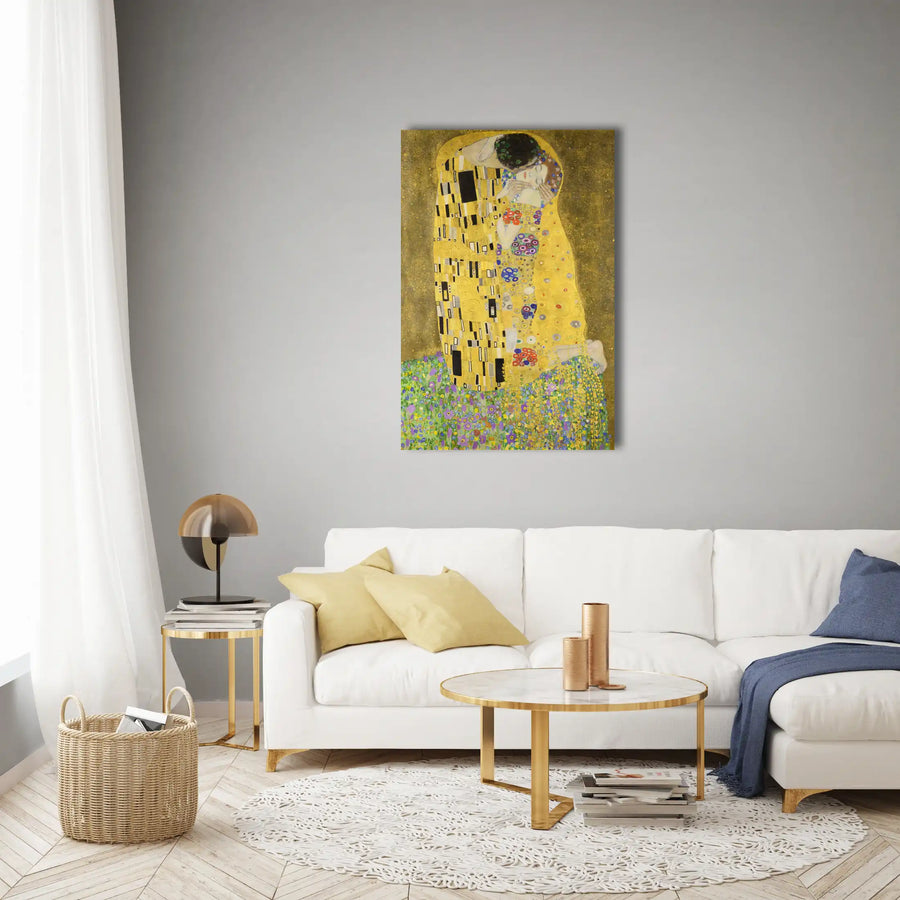
The Kiss — Gustav Klimt (1907–1908)
Klimt combines gold leaf, ornamental pattern and closely observed bodies. Rectangles, circles and flowers almost dissolve the couple into a decorative field, while faces and hands preserve intimacy. The painting shows how an artwork can bridge fine art, craft and design without reducing one to the other.

A canvas reproduction allows the contrast between gold, pattern and skin to be studied in a domestic setting. It should be understood as a reproduction of a public-domain work, not as an original painting.
Composition VII — Wassily Kandinsky (1913)
Composition VII gathers years of Kandinsky’s research into a dense field of colour, line and movement. Traces of flood, resurrection and catastrophe remain, but the painting does not require a single narrative. Its internal tensions provide the structure that representation once supplied.

The work is a useful test for abstract looking: follow repeated curves, colour clusters and changes in density before searching for a subject.
Broadway Boogie Woogie — Piet Mondrian (1942–1943)
In New York, Mondrian’s earlier black grid became a network of coloured pulses. Yellow lines, small red and blue blocks and interrupted rhythms suggest streets, traffic and boogie-woogie without illustrating them. The painting translates urban experience into a self-contained visual system.

Mondrian proves that restriction can generate movement. A few colours and right angles are enough when their intervals are precisely tuned.
Other masterpieces worth knowing
- The Scream by Edvard Munch: line and colour become an image of modern anxiety.
- Girl with a Pearl Earring by Johannes Vermeer: light and controlled edges create presence from very little narrative.
- Les Demoiselles d’Avignon by Picasso: fractured space announces a radical rethinking of representation.
- Water Lilies by Claude Monet: serial observation pushes landscape towards immersion and abstraction.
- The Persistence of Memory by Salvador Dalí: familiar objects obey the unstable logic of dream.
- The Great Wave off Kanagawa by Hokusai: design, movement and reproduction make a printed image globally resonant.
What connects them is not a shared style. Each changes the terms of attention: after seeing it, colour, space, a face or an ordinary object can no longer be understood in quite the same way.
Philosophy of art: what makes a work?
Philosophers have offered different answers because art itself has changed. Their theories are best treated as lenses: each clarifies one part of the problem and leaves another exposed.
Plato: imitation and suspicion
In Plato’s account, art often appears as imitation, removed from the truth of ideal forms. Images can stir emotion while offering only appearances, which makes them politically powerful and philosophically suspect. This critique still matters whenever images persuade more quickly than evidence.
Aristotle: catharsis and the universal
Aristotle grants representation a more constructive role. Tragedy organises action so that fear and pity can be experienced and understood. Art does not merely copy individual events; it can reveal patterns of human behaviour, giving form to what might otherwise remain chaotic.
Kant: disinterested aesthetic judgement
Kant describes aesthetic pleasure as disinterested: we attend to how something appears without needing to own or use it. This does not make art socially neutral. It identifies a distinctive mode of attention in which form can be considered without immediate practical demand.
Hegel: art and the history of spirit
For Hegel, art gives sensuous form to a culture’s understanding of itself. Its forms develop historically rather than according to an eternal standard. His famous discussion of art’s “end” does not predict the disappearance of artworks; it suggests that art no longer carries the highest spiritual truth in the same way it once did.
Duchamp: the artwork as a decision
Duchamp relocates artistic labour from the hand to the choice. A ready-made asks who can designate art, under what conditions and with what consequences. The museum, title, audience and critical debate become part of the work’s operation.
Today: plural definitions
Contemporary theories combine several approaches. Some emphasise institutions, others historical continuity, embodied experience, social use or the artist’s intention. Pluralism is not an excuse to call everything art; it means that claims must be argued through form, context and reception rather than settled by one timeless formula.
Art object versus work of art: what is the difference?
An art object is often a beautifully or skilfully made item with a decorative, ceremonial or practical function: a vase, tapestry, piece of jewellery or carved cabinet. A work of art is usually approached first as an expressive or conceptual proposition. The distinction is useful, but history constantly unsettles it.

Johannes Vermeer, Girl with a Pearl Earring, c. 1665, Mauritshuis, The Hague. Public-domain image.

The comparison turns on four points: primary purpose, the mode of attention requested, historical context and later reclassification. Interpretation is usually central to the work, while use and workmanship may dominate the art object. Illuminated manuscripts, ceremonial armour and design can convincingly belong to both categories.
The ready-made shows why the border cannot be policed by materials alone. The most useful question is not “Which box does this object enter?” but “What kind of attention and argument does it ask from us?”
Different forms of artistic expression
Art is not limited to objects that hang on a wall. Each medium organises space, time, bodies or information differently, and therefore asks for its own criteria of judgement.

Visual arts: painting, sculpture, drawing and printmaking
These practices transform materials into visible form. Painting works through surface, colour and touch; sculpture occupies or reorganises space; drawing records thought with extraordinary economy; printmaking makes repetition part of the work’s identity.
- Painting: from fresco and oil to acrylic and digital surfaces.
- Sculpture: carving, modelling, casting, assemblage and installation.
- Drawing: both preparatory instrument and autonomous work.
- Printmaking: woodcut, engraving, etching, lithography and screen printing.
Michelangelo’s life and works show how one artist can move between drawing, sculpture, monumental painting and architecture.
Performing arts: theatre, music, dance and cinema
Performing arts unfold in time and often depend on interpretation. A score is not identical to a concert; a script is not the same as a performance. Repetition therefore produces variation rather than a perfect copy.
- Theatre: text, voice, bodies, space and direction meet in a live event.
- Music: organised sound can carry structure without visual representation.
- Dance: movement turns the body into medium and archive.
- Cinema: image, duration, sound and editing create a reproducible temporal work.
This raises a productive question: where is the work located—in the instructions, the recording, the performance or the memory of those present? Different traditions answer differently.
Digital arts: video, interaction and generative systems
Digital art introduces code, interfaces and changing technical environments. Video art treats the electronic image as material; interactive work depends on the viewer’s action; generative art establishes rules from which multiple outcomes emerge.
- Video art: artists such as Nam June Paik revealed the expressive possibilities of the electronic signal.
- Interactive art: sensors and participation make reception part of production.
- Generative art: algorithms produce variation within parameters designed by a human author.
- Digital photography: capture, processing and circulation become one continuous workflow.
The relevant question is not whether a computer was used, but where choices, constraints and responsibility lie. Technology changes authorship; it does not remove the need to examine it.
Legal aspects of artistic creation
Law and aesthetics ask different questions. A creation can be artistically compelling without qualifying for copyright, while a legally protected work is not automatically important. The legal rules also vary by jurisdiction, so general guidance should not be mistaken for individual advice.
Intellectual property and copyright
Copyright generally protects an original expression once it is fixed in a perceptible form. It protects the particular form of a work, not a broad idea or style. In many countries, economic rights last for the author’s life plus seventy years, while moral rights may follow different rules.
- Originality: the work must reflect creative choices rather than mere mechanical effort.
- Expression: an idea becomes protectable through its concrete form.
- Economic rights: reproduction, distribution and adaptation may require permission.
- Moral rights: attribution and integrity can remain important even after ownership changes.
Appropriation art exposes the tension between quotation and infringement. The artistic argument may be strong while the legal position remains uncertain; each case depends on the material taken, the transformation and the applicable law.
Tax considerations when owning or selling art
Tax treatment depends on country, seller status, value, import route and whether the transaction concerns an original, limited edition or reproduction. Reduced VAT rates or special resale schemes may exist, but they should never be inferred from the artistic label alone.
Collectors and sellers therefore need precise documentation: authorship, provenance, invoices, edition information and export records. For a significant transaction, professional legal or tax advice is more reliable than a general article.
How the concept of art has evolved through history
The modern idea of the autonomous artwork is relatively recent. Earlier objects often combined ritual, political, practical and aesthetic functions that museums later separated.
- Antiquity: images and monuments served religious, civic and commemorative purposes; skill and imitation were central measures.
- Middle Ages: much European art served worship, and makers often worked within collective workshops rather than the modern cult of individual genius.
- Renaissance: theory, perspective and biography elevated the artist’s intellectual status.
- Eighteenth and nineteenth centuries: academies, museums and Romanticism strengthened ideas of taste, originality and personal expression.
- Modernism: artists questioned representation and explored the specific properties of colour, surface, material and space.
- Postwar and postmodern practices: performance, conceptual art and appropriation challenged the stable, unique object.
- Contemporary art: media, authorship and audiences are plural; ecological, digital and participatory practices continually redraw the field.
Following particular lives makes this evolution tangible. Our guide to fifteen essential French painters shows how successive generations inherited conventions and then shifted them.
Bringing public-domain art into the home
Many historical works by Klimt, Kandinsky, Mondrian, Van Gogh and Vermeer are now in the public domain in numerous jurisdictions. That makes faithful reproductions possible, although the status of a specific photograph, museum file or modern adaptation may differ from the underlying artwork.

A reproduction changes the encounter: scale, surface and setting differ from the museum original. Yet it can still sharpen looking. In a room, repeated contact often reveals patterns and colour relationships that a hurried visit misses. Collections devoted to Klimt, Kandinsky and Mondrian make those comparisons easier.
Frequently asked questions
What separates a work of art from an ordinary object?
The difference usually lies in a combination of intention, framing, form, historical relationship and reception. No item on its own is decisive, which is why a readymade can become art and a skilfully made object can remain primarily functional.
- The maker proposes an artistic or critical use.
- Formal decisions sustain attention beyond practical function.
- The work enters a history of images, objects or performances.
- Viewers, critics or institutions can test and contest its claims.
- Its meaning is not exhausted by immediate use.
How is the value of a work of art determined?
Artistic, historical, symbolic and market value do not necessarily coincide. Price is produced by scarcity, provenance, condition, demand and institutional recognition, but a high auction result is not a verdict on artistic importance.
- Formal quality: the coherence and force of the work’s decisions.
- Historical importance: its role in a movement or change of language.
- Provenance and condition: the documented life and material state of the object.
- Cultural meaning: the communities and debates for which it matters.
- Market demand: the current balance of rarity, reputation and buyers.
Where can I learn more about art history?
Begin with works themselves, then compare museum records, catalogues and reliable scholarship. A good source identifies the object, date, medium, location and limits of interpretation.
- Collection pages and essays from major museums.
- Exhibition catalogues and artist catalogues raisonnés.
- University courses and public lectures with named specialists.
- Foundational surveys such as E. H. Gombrich’s The Story of Art, read alongside newer and more global histories.
- Focused Art Virtuoso guides that link formal analysis to historical context.
Further reading
No final definition can contain every artwork without becoming empty. The most durable method is to combine close looking with historical and conceptual questions: what has been made, how does it work, what does it claim, and who is invited—or excluded—from recognising it?
For deeper study, the following books offer distinct and sometimes conflicting tools rather than a single answer.
- Arthur C. Danto, The Transfiguration of the Commonplace.
- Nelson Goodman, Languages of Art.
- Hans Belting, An Anthropology of Images.
- Anne Cauquelin, Theories of Art.
- Marc Jimenez, What Is Aesthetics?.
The question “Is this art?” is therefore not a failure to understand. Asked carefully, it is the beginning of attention. It forces us to examine the object, the gesture, the institution and our own expectations—and that examination is one of art’s most lasting achievements.