


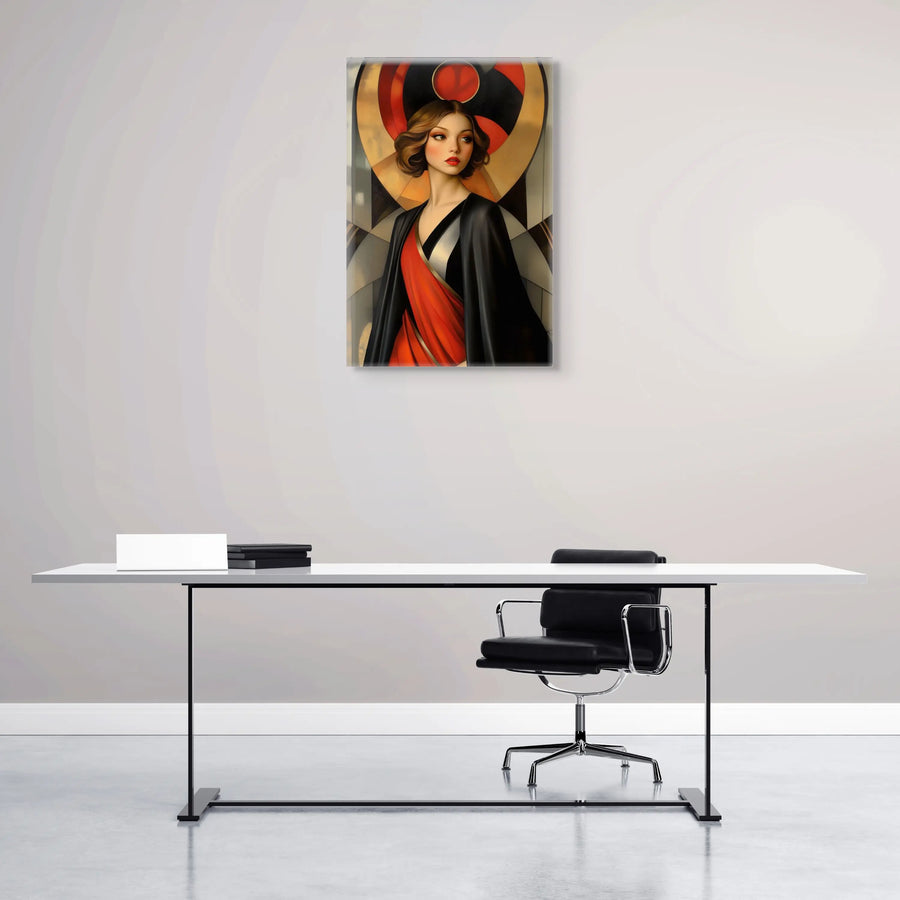

Art Deco Painting: Style, History and Key Works
Art Deco Painting: Complete Guide and Iconic Examples
Imagine a world where geometry dances with elegance, where bold colors wed luxury, and where modernity flirts with glamour. Welcome to the dazzling universe of Art Deco painting, the artistic movement that transformed the 1920s and 1930s into a visual feast whose echoes still resound in our contemporary culture!
What Is Art Deco Painting? The Art That Made the Interwar Years Shine
If I had to describe Art Deco painting to someone discovering it for the first time, I would say it is to art what a vintage champagne is to drinks: sophisticated, effervescent, and possessed of a certain je-ne-sais-quoi that makes it irresistibly alluring.
Definition and origins of the style: when art dresses itself in luxury
The term "Art Deco" (short for Arts Décoratifs) has its origins in the Exposition internationale des Arts Décoratifs et industriels modernes held in Paris in 1925. This event consolidated a style that had begun to emerge as early as the 1910s, born from the ashes of Art Nouveau and nourished by artistic avant-gardes such as Cubism and Futurism.
Art Deco is not merely a pictorial style — it is a global aesthetic that touched architecture, interior design, fashion, jewelry, and even graphic arts. But its manifestation in painting is particularly dazzling and revealing of the spirit of the age.
"Art Deco is the visual expression of an era that simultaneously celebrated tradition and modernity, luxury and functionality, craftsmanship and industry."
Principal stylistic characteristics: when geometry becomes glamorous
Art Deco painting is distinguished by several characteristics that make it an immediately recognizable style:
- Bold geometry: Straight lines, sharp angles, simplified geometric forms
- Symmetry and balance: Often highly structured compositions
- Color palette: Contrasting tones, vivid colors as well as the use of black, white, gold and silver
- Stylized elegance: Rejection of the natural in favor of a refined and pared-back representation
- Influence of diverse cultures: Egyptian, Aztec, African and Asian inspirations
- Celebration of modernity: Representations of urban life, machines, skyscrapers
During my visit to the Musée des Arts Décoratifs in Paris last year, I was struck by the visual coherence of the Art Deco works, as if all these artists had participated in a collective aesthetic conversation while each retaining their own individual voice.
Colors and palettes: the art of chromatic boldness
The Art Deco palette is instantly recognizable. It navigates between:
- Vivid and deep hues: ruby red, sapphire blue, emerald green
- Metallic colors: gold, silver, bronze
- Striking contrasts: black and white, vibrant complementary colors
- Sophisticated pastels: powder pink, sky blue, lilac
These colors were not chosen at random, but skillfully orchestrated to create an impression of luxury and modernity. Art Deco artists often used flat colors, without complex gradients, reinforcing the graphic quality of their works.
Geometric forms and motifs: when triangles, circles and zigzags come alive
Art Deco motifs are a true signature of the movement:
- Zigzags and chevrons
- Stylized sunbursts
- Interlocking geometric forms
- Cascade patterns
- Stepped forms and ziggurat shapes
- Concentric circles
These motifs appear both in the main compositions and in the decorative details of works. They create a dynamic visual rhythm that gives Art Deco paintings their characteristic energy.
Themes and subjects depicted: between glamour and machinery
Art Deco painters were particularly fond of:
- Elegant portraits of modern women
- Urban scenes and skyscraper landscapes
- Automobiles, trains, ocean liners and other symbols of modernity
- Society scenes and the luxury of high society
- Stylized floral motifs
- References to Antiquity and "exotic" cultures
These themes perfectly reflect the spirit of the "Roaring Twenties," that post-war period characterized by a thirst for modernity, movement and pleasure.
The Masters of Art Deco Painting: The Artists Who Defined an Era
If the Art Deco style is so emblematic today, it is thanks to the talent of exceptional artists who captured the spirit of their age. Among them, one woman established herself as the true icon of the movement.
Tamara de Lempicka: the flamboyant icon of Art Deco
It is impossible to speak of Art Deco painting without evoking Tamara de Lempicka, the undisputed queen of the movement. Born in Poland in 1898, this artist with a romantic destiny fled the Russian Revolution to reinvent herself in Paris in the 1920s.
Lempicka embodies the spirit of Art Deco singlehandedly: modern, bold, sensual and sophisticated. Her life, as flamboyant as her work, makes her a fascinating figure in art history.
Style and technique of Tamara de Lempicka: sensual modernity
Lempicka's style is immediately recognizable:
- Sculptural faceted forms, as if carved from metal
- Sharp and precise contours, almost architectural
- A cool yet vibrant color palette
- Tubular treatment of forms, inspired by Cubism
- Plays of light and shadow creating a metallic volumetric effect
- Bold and unconventional sensuality
Her unique pictorial technique paradoxically combines warmth and coolness, creating a captivating visual tension. Lempicka often used very fine brushes to achieve a smooth, glossy, almost photographic finish.
Iconic works of Tamara de Lempicka: glamour elevated to art
Among the masterpieces of this extraordinary artist:
- "Self-Portrait (Tamara in the Green Bugatti)" (1929): Perhaps her most celebrated work, it became the emblem of the independent, sophisticated modern woman of the 1920s.
- "La Belle Rafaëla" (1927): A sensual nude with geometricized curves that perfectly illustrates her ability to combine eroticism and formal rigor.
- "Portrait of the Duchess of La Salle" (1925): An elegant portrait capturing the essence of the Roaring Twenties aristocracy.
- "The Two Friends" (1923): A bold work exploring feminine sensuality with striking modernity.
Lempicka's influence on the Art Deco aesthetic is such that, even today, her style is often the first to be evoked when speaking of Art Deco painting.
"My goal was not to win. It was to create my own style, which I knew to be very personal and unique."
Other important Art Deco painters: the artists who shaped the movement
Although Lempicka is the figurehead of Art Deco painting, other remarkable artists contributed to defining this style:
| Artist | Characteristics | Notable works |
|---|---|---|
| Jean Dupas | Elegant elongated figures, monumental compositions | "Les Perruches" (1925), SS Normandie frescoes |
| Cassandre | Geometric posters, bold typography | "Normandie" (1935), "Étoile du Nord" (1927) |
| Erté (Romain de Tirtoff) | Stylized elegance, Oriental influences | Harper's Bazaar covers, "Alphabet" series |
| Paul Colin | Dynamic theater posters, celebration of Parisian life | "Revue Nègre" (1925), portraits of Josephine Baker |
| René Lalique | Glass art, stylized natural motifs | Vases, jewelry, decorative panels |
Each of these artists brought their unique vision to the Art Deco aesthetic, diversifying and enriching a movement that transcended the boundaries between fine arts and decorative arts.
Where to Find Art Deco Paintings? In Search of Geometric Treasures
For Art Deco enthusiasts wishing to admire or acquire works from this period, several options are available.
Art galleries and specialist museums: the temples of Art Deco
Several cultural institutions around the world hold important collections of Art Deco works:
- Musée des Arts Décoratifs (Paris): An exceptional collection of Art Deco works, including furniture, paintings and decorative objects.
- Victoria and Albert Museum (London): A dedicated Art Deco section with remarkable pieces.
- Metropolitan Museum of Art (New York): Modern art gallery with a fine selection of Art Deco works.
- Wolfsonian-FIU (Miami Beach): Museum specializing in decorative arts from the period 1885–1945.
- Art Deco Museum (Miami): As its name suggests, entirely dedicated to Art Deco art and architecture.
During my visit to the Musée des Arts Décoratifs last year, I was captivated by the breadth and quality of their Art Deco collection. The permanent exhibition allows you to understand how this style influenced every aspect of daily life, from jewelry to furniture to paintings.
Art markets and auctions: in search of Art Deco gems
For collectors, several options exist to acquire Art Deco works:
- Auction houses: Christie's, Sotheby's and Drouot regularly organize specialist Art Deco sales.
- Specialist fairs: La Biennale Paris, PAD London and Paris, TEFAF Maastricht.
- Specialist galleries: DeLorenzo Gallery (New York), Galerie Marcilhac (Paris), Galerie Willy Huybrechts (Paris).
Be aware, however: the popularity of Art Deco has generated strong demand, and prices can be very high for pieces signed by renowned artists. A painting by Tamara de Lempicka can fetch several million dollars at international auctions.
Websites and online platforms: Art Deco at the click of a button
The internet also offers many resources for discovering and acquiring Art Deco art:
- 1stDibs: Platform specializing in quality antiques and art, with a fine Art Deco section.
- Artsy: Regularly features Art Deco works from galleries around the world.
- Catawiki: Online auctions with a dedicated Art Deco category.
- Pamono: Specializing in vintage design and decorative arts.
These platforms provide access to a wide range of works, from affordable reproductions to authentic collector's pieces.
How to Identify an Authentic Art Deco Painting? The Connoisseur's Eye
With the growing popularity of Art Deco, the market has seen a proliferation of imitations and pastiches. Here are some tips for recognizing an authentic work.
Key points for authenticating a work: the devil is in the details
- Dating: Verify that the work actually dates from the Art Deco period (approximately 1910–1940).
- Materials and techniques: Examine the quality of the materials and the techniques used, which should correspond to those of the era.
- Provenance: The ownership history is crucial for establishing authenticity.
- Signatures: Familiarize yourself with the signatures of the artists you are looking for.
- Stylistic coherence: Ensure that all stylistic elements correspond to the Art Deco aesthetic.
During a visit to a specialized Parisian gallery, the owner confided to me that even experts can sometimes be fooled by high-quality fakes. Hence the importance of calling on recognized specialists to authenticate a work before making a significant purchase.
Tips for avoiding counterfeits: the art of prudence
For beginning or experienced collectors:
- Education: Train your eye by visiting museums and consulting reference works.
- Certification: Require certificates of authenticity and verify their provenance.
- Expert appraisal: Don't hesitate to call on an independent expert for important acquisitions.
- Reputation: Buy from established and reputable sellers.
- Research: Check whether the work features in catalogue raisonnés or past exhibitions.
Remember that in the art world, a deal that seems too good to be true generally is!
Art Deco Today: The Influence and Legacy of a Timeless Style
Although the golden age of Art Deco is behind us, its influence continues to radiate through our contemporary visual culture.
Art Deco in contemporary art: resurgence of an emblematic style
Many contemporary artists draw inspiration from the Art Deco aesthetic:
- Fashion photographer Mario Testino often creates compositions that recall Lempicka's portraits.
- Digital artist Rafael Varona incorporates Art Deco elements into his elegant animations.
- Illustrator Robert McGinnis, known for his film posters, employs an aesthetic strongly influenced by Art Deco.
- Artist Sonia Alins combines Art Deco and Surrealism in her contemporary works.
These contemporary artists are not simply copying the Art Deco style, but reinterpreting and updating it, proving its continuing relevance in today's artistic landscape.
The persistence of the Art Deco style in modern design: eternal elegance
The influence of Art Deco is particularly visible in:
- Graphic design: Geometric typefaces, symmetrical compositions, contrasting palettes.
- Fashion: Collections inspired by the 1920s–30s, use of geometric motifs.
- Contemporary architecture: Numerous skyscrapers incorporating Art Deco stylistic elements.
- Cinema: Art direction of films such as "The Great Gatsby" or "Metropolis."
Art Deco regularly experiences resurgences in design trends, as evidenced by the recent enthusiasm for geometric patterns and vivid colors in contemporary furnishings.
Art Deco in interior decoration: how to incorporate this style at home
For those wishing to bring an Art Deco touch to their interior:
- Opt for quality reproductions of emblematic paintings from the movement.
- Choose contrasting colors: black and gold, black and white, teal and silver.
- Incorporate geometric forms in your furniture and decorative accessories.
- Favor luxurious materials: glass, chrome, exotic woods, marble.
- Don't hesitate to blend modern minimalism with Art Deco touches for a contemporary interior.
I recently visited a Parisian apartment where the owners had judiciously mixed contemporary furniture with Art Deco elements, creating a space that was at once current and timeless. A reproduction of Lempicka's "La Musicienne" presided above an ultra-modern fireplace, creating a fascinating dialogue between past and present.
Conclusion: Art Deco, a Style That Continues to Enchant Us
Art Deco painting is not just a chapter in art history; it is a style that has transcended its era to become a timeless visual language. Its influence extends far beyond canvases, touching almost every aspect of our visual culture.
What makes Art Deco so fascinating is its capacity to reconcile contradictions: it is at once modern and classical, geometric and sensual, minimalist and decorative. This creative tension perhaps explains why this style continues to captivate us nearly a century after its heyday.
So, whether you are a seasoned collector, an art lover or simply curious, I invite you to explore this extraordinary movement. Visit museums, leaf through art books, and perhaps even let yourself be tempted by an Art Deco piece for your interior. Because Art Deco is more than an artistic style — it is a celebration of glamour, boldness and the joy of living that continues to inspire us today.
For further reading: recommended resources
- "Tamara de Lempicka: A Life of Deco and Decadence" by Laura Claridge
- "Art Deco: The Golden Age of Graphic Art and Illustration" by Michael Robinson and Rosalind Ormiston
- "Art Deco Complete: The Definitive Guide to the Decorative Arts of the 1920s and 1930s" by Alastair Duncan
- "Art Deco" by Alastair Duncan (Architecture & Design collection)
- "The World of Art Deco" by Bevis Hillier