


Tree of Life: Meaning, Symbols and History
A tree with a broad crown and visible roots is instantly readable, yet its meaning is never automatic. In Norse poetry it may evoke Yggdrasil; in Maya art, a world centre; in Buddhist memory, the place of awakening. This guide follows those distinct histories before showing how the motif works in jewellery, tattoos and interior art.
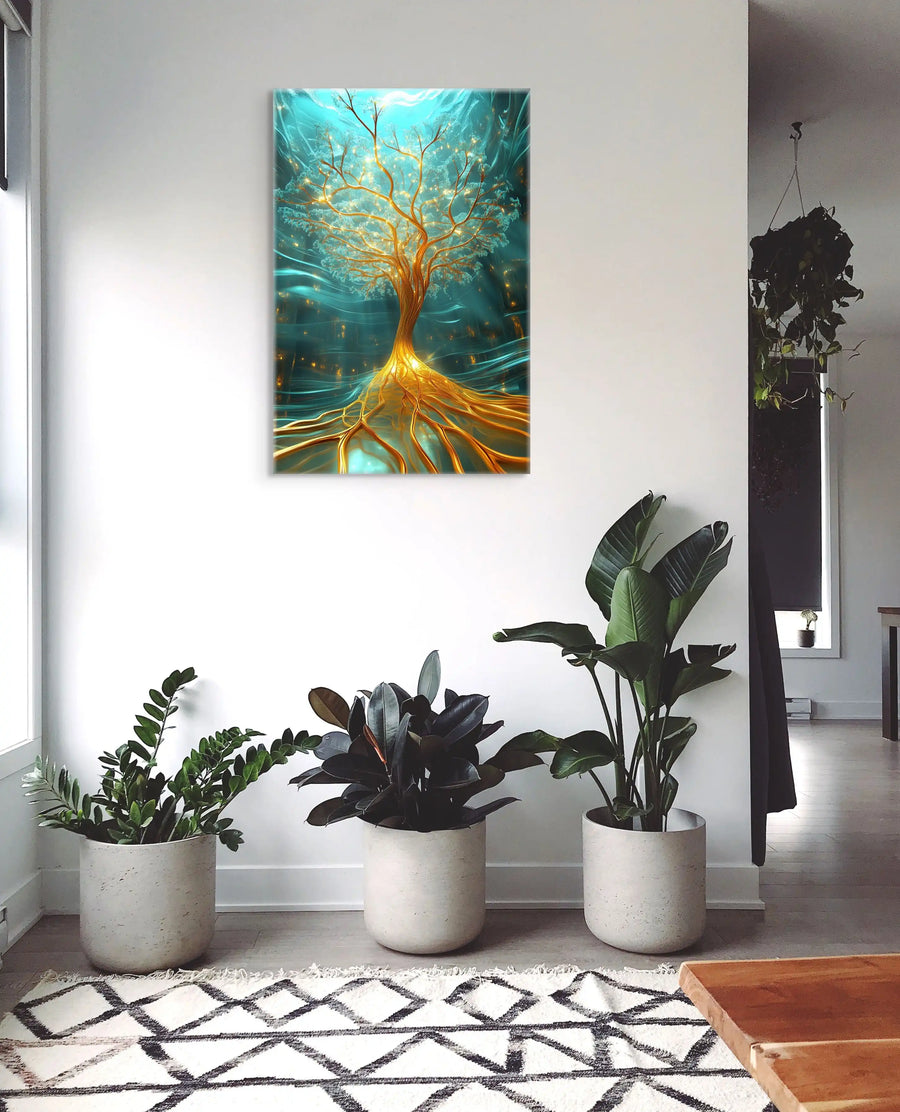
 A text-free room scene shows how the motif can work as a single piece or a coordinated trio.
Definition and Origins of the Tree of Life

What Do We Mean by “Tree of Life”?
Tree of Life is a convenient umbrella term for tree motifs that organise a cosmos, mark a sacred place, connect realms or embody continuity. The label helps us compare images, but it should not erase the differences between the texts, rituals and societies that produced them.
Roots, trunk, branches, leaves and fruit offer artists a rich visual grammar: origin and descent, support and growth, death and renewal, earth and sky. Some compositions are enclosed in a circle; others rise vertically like an axis. These formal choices guide interpretation before any single religious meaning is assigned.
 Roots, trunk and crown offer a compositional framework; cultural context determines the precise interpretation.
A Recurring Motif, Not One Universal Doctrine
Sacred and cosmic trees appear in many regions and periods, from the ancient Near East to medieval Europe and the Americas. Museums also warn us that the precise meaning of a “sacred tree” can remain uncertain even when the motif is easy to recognise. Resemblance is therefore a starting point for comparison, not proof of a single shared origin.
The tree’s own life cycle helps explain its appeal. Growth from seed, seasonal change, fruit and new seed make it a persuasive metaphor for continuity. Evergreen and deciduous species can suggest different ideas, and cultures select those features in different ways.
Reading rule: identify the culture, date, species and surrounding figures before calling an image a “Tree of Life”. Context is more reliable than visual similarity alone.
Roots & Legends: Test What the Images Really Mean
Loading the quiz…
Tree and World: Meanings Across Distinct Traditions

Comparisons are useful when they preserve difference. The following examples show how a tree can organise space, memory or hope without becoming the same symbol everywhere.
The Tree of Life in the Bible and Christian Art
Genesis places the Tree of Life and the Tree of the Knowledge of Good and Evil in Eden. After the human pair eat from the forbidden tree, access to the Tree of Life is guarded. The text distinguishes the two trees; later interpretations explore immortality, wisdom, obedience and loss.
Christian art later connected the cross with a new Tree of Life, especially in medieval images where branches, fruit or genealogy transform an instrument of death into a sign of salvation. This is a history of interpretation, not a botanical identification. Our guide to abstract art offers another way to see how form can carry layered ideas.
Trees in Islamic Texts and Art
The Qur’an contains several important tree images. Surah 53 names Sidrat al-Muntaha, the lote tree at the furthest boundary, while other passages evoke blessed trees and gardens. These references should not be collapsed into a single Qur’anic object called “Shajarat al-Hayat”.
In Islamic art, branching plants, palmettes and garden imagery can suggest abundance, paradise or dynastic order. Meaning depends on medium and context: a carpet field, manuscript illumination and architectural tile do not necessarily use vegetal ornament in the same way.
The Tree of Life in Judaism and Kabbalah
Etz chaim, “tree of life”, appears in Jewish life through Genesis, Proverbs and the Torah metaphor. In Kabbalah, the ten sefirot describe divine emanations or attributes and are often arranged in a branching diagram.
The familiar Tree of Life diagram developed through medieval and early-modern mystical traditions. The ten sefirot and the twenty-two Hebrew letters can be discussed as “thirty-two paths of wisdom”, but one should not treat every diagram as an unchanged image from biblical times.
The Bodhi Tree and the Hindu Aśvattha
In Buddhism, the Bodhi tree at Bodh Gaya marks the place of the Buddha’s enlightenment. The living tree and its descendants are sites of memory and devotion. Calling it a Tree of Life can be a modern comparison, but “Bodhi tree” is the culturally precise term.
In the Bhagavad Gita, an inverted aśvattha has roots above and branches below. The term refers to the sacred fig or peepal; it should not be casually replaced by “banyan”. The image presents a philosophical cosmos that must ultimately be understood and transcended.
Sacred Trees in Celtic-Speaking Societies
Trees, groves and particular species held important roles in several Celtic-speaking societies, and later Irish literature preserves rich tree lore. The modern phrase Crann Bethadh simply means “tree of life” in Irish; online claims about one pan-Celtic doctrine, a mandatory village tree or a universal death penalty for felling it are not securely documented.
Contemporary Celtic-style designs remain visually compelling. Interlace can connect root and branch in an endless rhythm, but it is more accurate to describe these works as modern interpretations informed by Celtic art than as exact copies of one ancient emblem.
Public art also turns trees into gathering points today. Our introduction to urban art explores how location changes the way an image is read.
Yggdrasil in Norse Mythology
Old Norse poems describe Yggdrasil as the immense tree around which gods, beings, wells and realms are organised. It is often called an ash in modern retellings, although the surviving sources do not support every tidy botanical or geographic detail repeated in popular charts.
An eagle occupies its upper reaches, the serpent or dragon Níðhöggr works below, and the squirrel Ratatoskr carries hostile words between them. The image is dynamic: the tree supports the cosmos while also enduring pressure, decay and renewal.
Tree-Goddess Imagery in Ancient Egypt
Egyptian tomb art includes goddesses emerging from sycamore figs to offer water and food to the deceased. Hathor and Nut are especially associated with tree-goddess imagery in different contexts; reducing the whole tradition to an “Isis tree” obscures that variety.
Nebamun’s garden, for example, shows a goddess leaning from a tree while a sycamore addresses the tomb owner. The scene belongs to a broader funerary world of gardens, offerings and continued life, rather than to one fixed object officially named the Egyptian Tree of Life.
The Maya World Tree and Chinese Peaches of Immortality
Ancient Maya art uses great world trees to mark the four directions and the centre, linking underworld, human realm and sky. The ceiba remains sacred in Maya communities, but this tradition should not be generalised to all Indigenous peoples of the Americas.
Chinese art offers a different image: the peaches of Xiwangmu, Queen Mother of the West, signify longevity and immortality. The famous fruiting interval of three thousand years belongs to mythology and auspicious imagery; it is not evidence of a botanical “Tree of Life” shared with the Maya.
| Tradition | Precise motif | Primary context | Key idea |
|---|---|---|---|
| Biblical / Christian | Tree of Life; later cross-tree imagery | Scripture and Christian art | Life, salvation, interpretation |
| Jewish mysticism | Etz Chaim / sefirotic diagram | Kabbalistic theology | Ten divine emanations |
| Buddhist | Bodhi tree | Bodh Gaya and awakening | Enlightenment and memory |
| Hindu | Inverted aśvattha | Bhagavad Gita | Cosmos and liberation |
| Norse | Yggdrasil | Old Norse poetry | Cosmic structure and fate |
| Maya | World trees / ceiba | Cosmology and kingship | Directions, centre, realms |
| Chinese | Peaches of Xiwangmu | Myth and auspicious art | Longevity and immortality |
How to Read Tree of Life Symbolism

Once cultural context is established, formal details reveal how a particular artwork develops its meaning. Shape, species, colour and surrounding motifs matter as much as the general tree silhouette.
Growth, Strength and Resilience
A trunk rising from a small root system can make growth visible. A storm-bent tree may suggest endurance; a flourishing crown, vitality. These are persuasive metaphors, not measurable effects produced by the object.
Material changes the reading too. A fine ink line feels fragile and contemplative, while a dense metal silhouette may emphasise weight and stability.
Knowledge, Connection and Orientation
Root and crown can link below and above; branching lines can map relationships or expanding knowledge. Similar structures also appear in diagrams, networks and abstract art, where rhythm and repetition carry meaning without a literal narrative.
The safest interpretation begins with what the composition actually shows, then tests symbolic associations against the work’s title, date and cultural setting.
Family, Ancestry and Memory
A tree is an intuitive family image because one trunk divides into many branches. Roots can suggest ancestors; new shoots, descendants; rings, accumulated time.
The resemblance does not prove that the modern family tree descends directly from one ancient Tree of Life tradition. Genealogical diagrams have their own varied history, even when they use the same visual analogy.
Renewal, Mortality and Continuity
Bud, leaf, fruit and seed can stage continuity without promising literal immortality. Deciduous change suggests return after dormancy; an evergreen may emphasise persistence.
The same passage from ending to new beginning appears in the symbolism of the phoenix. The tree expresses it through seasonal cycles; the firebird condenses destruction, transformation and renewed flight.
Harmony, Balance and Composition
Many decorative Trees of Life balance roots and branches across a central axis. Symmetry can create calm; asymmetry can make growth feel more organic and alive.
Balance is a visual quality, not proof that the object will “harmonise” a home. The practical question is whether its proportions, contrast and palette work with the wall and surrounding furniture.
Protection and Stability as Personal Meanings
A broad canopy and deep roots can be interpreted as shelter and stability. People may also adopt the motif as a personal reminder of values, family or recovery.
Those meanings deserve respect without turning them into guarantees. A painting or pendant can support reflection; it does not protect against harm or remove “negative energy”.
The Tree of Life in Modern Art and Everyday Objects
Contemporary artists and designers reuse the motif because its branching structure can move between figuration, ornament and abstraction.
Jewellery: Meaning, Material and Wear
A pendant or ring may mark family continuity, a new beginning or simply an attraction to botanical geometry. That personal meaning is more credible than a generic promise of spiritual benefit.
Check metal, plating thickness, clasp, stone setting and care instructions. If a piece borrows knots, sefirotic forms or another identifiable tradition, look for a maker who names the reference accurately.
Tattoos: Choose the Reference Before the Style
A tattoo can commemorate family, recovery or a life transition. Decide first whether you want a generic branching tree, Yggdrasil, a Bodhi reference or a Celtic-inspired interlace; these choices are not interchangeable.
Ask the artist how the roots and crown will remain legible as the tattoo ages. Fine lines, dense knots and small text require different scale and aftercare decisions.
Interior Art: Scale, Palette and Placement
A Tree of Life wall artwork can act as a calm central image or a high-contrast graphic anchor. Choose it as you would any artwork: by dimensions, dominant colours, viewing distance and the amount of detail the room can support.
If you prefer a less literal image, our guide to choosing abstract art explains how colour, gesture and format shape a room.
Using the Motif for Reflection—Without Magical Claims

The motif can support a ritual of attention because it gives the eye a stable form to return to. Any benefit comes from the practice and the meaning you give it, not from a proven power inherent in the object.
A Personal or Spiritual Anchor
Someone may use roots as a prompt to think about belonging, the trunk as present commitments and branches as future possibilities. Another viewer may simply respond to the composition.
Neither response is more authentic. The important distinction is between a chosen symbolic practice and a claim of objective therapeutic effect.
Luck and Protection: Belief, Not Guarantee
Tree amulets and auspicious images can carry protective or fortunate meanings within particular communities and families. Describe them as beliefs, wishes or traditions rather than as mechanisms that repel harm.
When giving the motif, a short note explaining your intention—continuity, courage, remembrance—often gives the object more meaning than a generic “good energy” formula.
Meditation and Personal Growth
During a short visualisation, roots can cue attention to physical support and branches can cue a wider perspective. This may help organise a moment of reflection, much like a landscape, breath count or written prompt.
It is not a substitute for medical or psychological care. Keep the language proportional: a useful image for reflection, not a treatment.
Choosing a Tree of Life Artwork or Object

Start with the intended use: a central wall piece, a small personal object or a gift. Then compare form and quality rather than relying on a long list of promised virtues.
For Jewellery and Small Objects
Choose the meaning you want to carry—family, continuity, remembrance or growth—then decide whether the design should be minimal, figurative or tied to a specific tradition.
Gemstones add colour, texture and cost; they do not add scientifically established “energetic properties”. For daily wear, construction and finish matter more: secure setting, smooth edges, repairable clasp and clear material disclosure.
If authenticity matters, ask who made the piece and how its symbols were selected. Cultural specificity is a strength when it is named and handled with care.
For Wall Art and Interior Objects
Wood brings grain and warmth, metal produces a sharp silhouette, textile softens the room, and printed canvas offers colour and scale. Each material changes the image’s presence; none carries an inherent spiritual energy.
Measure the complete outer dimensions, including any frame. A useful starting point above a sofa or console is a work or group that occupies roughly half to two-thirds of the furniture width, adjusted for the room and viewing distance.
Finally, check whether dense branches remain legible from the main viewpoint. A highly detailed tree needs more scale or a quieter wall than a simple circular silhouette.
Frequently Asked Questions About the Tree of Life

How Does the Tree of Life Differ from the Tree of Knowledge in Genesis?
Genesis names two trees in Eden: the Tree of Life and the Tree of the Knowledge of Good and Evil. The prohibition concerns the latter. After the transgression, cherubim guard access to the Tree of Life. Later Jewish and Christian interpretations develop their meanings, but the biblical narrative does not treat them as the same tree.
Is the Tree of Life Directly Connected to Genealogy?
It is connected by a strong visual analogy: one origin branches into several lines, while roots suggest ancestry. Yet the history of genealogical diagrams is varied, so it is more accurate to say the family tree uses a comparable structure than to derive it directly from one ancient Tree of Life symbol.
Can You Give a Tree of Life as a Gift?
Yes. Its flexibility is precisely what makes it useful: it can mark a birth, marriage, move, recovery or remembrance. Explain the meaning you intend instead of assuming the recipient shares one “universal” interpretation. For bereavement or religious occasions, cultural and personal sensitivity matters more than a stock formula.
A meaningful gift is specific: name the memory, relationship or new beginning the tree represents. The explanation becomes part of the object.
Tree imagery endures because it can hold structure and movement at once: roots gather, a trunk supports, branches diverge. Its histories are plural, and that plurality makes the motif richer rather than weaker.

Before choosing a work, decide whether you are drawn to a specific tradition or to the broader visual language of growth and connection. That distinction will guide both interpretation and design.
Discover our Zen and contemplative wall art, where tree imagery appears alongside other quiet, reflective motifs.
Sources and Further Reading
- The Metropolitan Museum of Art — Neo-Assyrian plaque in the form of a tree.
- The Metropolitan Museum of Art — Maya deity and the raising of world trees.
- National Museum of Denmark — Norse religion and Yggdrasil.
- UNESCO — Mahabodhi Temple Complex at Bodh Gaya.
- My Jewish Learning — Etz Chaim and the ten sefirot.
- Qur’an 53:14 — Sidrat al-Muntaha.
- British Museum — Peaches of immortality and Xiwangmu.
- Smarthistory / British Museum — Nebamun’s garden and the tree goddess.