René Magritte: The Master of Surrealist Enigma
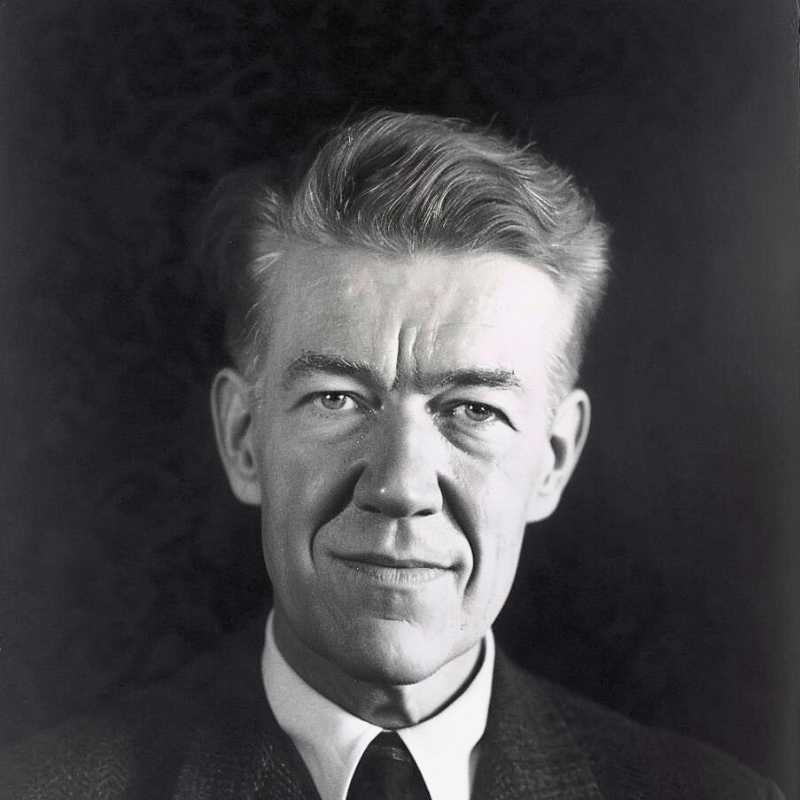
René Magritte, the celebrated Surrealist painter, left his mark on art history with his enigmatic works that defy our perception of reality. Born in Belgium in 1898, Magritte transforms the everyday into a series of visual riddles, playing with objects and their representations to explore the mysteries of the unconscious.
Through recurring motifs such as the apple, the bowler-hatted man, and blue skies, he creates a Surrealist universe where the visible and the invisible coexist. This article delves into the life and work of Magritte, revealing how he became an iconic figure of the avant-garde.
Youth and Early Influences

A Beginning Marked by Tragedy
Magritte's youth was profoundly marked by his mother's suicide when he was only 14, an event that would recurringly influence the themes of absence and concealment in his work. This period of his life sowed the first seeds of his questioning of reality and the mystery surrounding it.
The Royal Academy of Fine Arts and Early Experiments
Magritte began his studies at the Royal Academy of Fine Arts in Brussels in 1916, where he experimented with Impressionism before moving toward Futurism and Cubism. This was a period of experimentation that laid the groundwork for his Surrealist exploration of reality.
The Surrealist Awakening
The discovery of Giorgio de Chirico's work and his encounter with the Brussels Surrealist group in 1924 marked a turning point in his career. Magritte was fascinated by Chirico's dreamlike and enigmatic approach, which prompted him to develop his own Surrealist style, characterized by a deep exploration of the contradictions between the visible and the invisible.
Magritte and Surrealism in Paris

René Magritte's Parisian period, from 1927 to 1930, marks a crucial chapter in his artistic career, placing him at the heart of the Surrealist movement then bubbling in the French capital. His integration into the circle of Surrealists, led by the charismatic André Breton, had a profound impact on his artistic development, although their relationship was far from harmonious.
-
Immersion in Surrealism: In Paris, Magritte was immediately plunged into an environment teeming with revolutionary ideas and unbridled creativity. The energy and innovation of the Surrealist group stimulated his imagination, encouraging him to push his explorations of the irrational and the unconscious further. This period was marked by intense artistic production, in which Magritte refined his approach to Surrealist painting, distinguishing himself through his use of imagery to defy logic and question reality.
-
The Relationship with André Breton: The dynamic between Magritte and Breton was complex. Breton, often considered the pope of Surrealism, was both a mentor and a critic for members of the movement. Although Magritte admired Breton for his intellect and his vision, tensions arose over certain ideas and the direction of Surrealism. These tensions reflected internal debates within the movement about the nature of Surrealist art and its political engagement, notably around the question of Communism.
-
Philosophical Enrichment and Rebellion: Despite these tensions, the influence of Breton and other Surrealists such as Paul Éluard, Salvador Dalí, and Max Ernst is undeniable in Magritte's evolution. These interactions allowed him to explore new conceptual terrain, enriching his work with philosophical and poetic depth. Magritte adopted automatic writing, the exquisite corpse, and other Surrealist techniques to probe the unconscious, while remaining faithful to his unique vision.
-
Return to Brussels: In 1930, Magritte returned to Brussels, carrying with him the lessons learned in Paris. This Parisian period had consolidated his identity as a Surrealist painter, though he continued to develop his personal style, often at the margins of the stricter directives imposed by Breton. His return to Belgium marked the beginning of a new phase in his career, in which he deepened and broadened his exploration of the mysteries of perception and reality.
Magritte's Parisian period is therefore essential for understanding his integration and contribution to Surrealism. His capacity to maintain his artistic individuality while engaging in the debates and collaborations of the group attests to his unique place in art history.
The Major Works of René Magritte

René Magritte left an indelible mark on modern art with his enigmatic works. Here is a detailed overview of his most emblematic paintings:
-
The Treachery of Images (This Is Not a Pipe) (1929): This canvas is one of Magritte's most famous, highlighting the gap between an object and its representation. With the inscription "This is not a pipe," Magritte questions the nature of representation and how words and images relate to their referent in the real world. This work perfectly illustrates the conceptual and poetic approach of Surrealism, playing with the idea that perception can never be entirely reliable.
-
The Son of Man (1964): In this mysterious portrait, the subject's face is obscured by a floating apple, defying the conventions of representation and identity. The work embodies Magritte's fascination with the unconscious, automatism, and the dreamlike — themes dear to Surrealists such as André Breton and Paul Éluard. This painting invites reflection on the way we hide our true nature behind symbols and illusions.
-
The Empire of Light (1954): This series of paintings juxtaposes daytime and nocturnal scenes within the same frame, creating an ambiguity between day and night, dream and reality. The work explores duality and ambiguity, recurring themes in the Surrealist movement. It illustrates Magritte's capacity to transcend the limits of Realism and to plunge the viewer into a Surrealist universe where the laws of nature and logic are constantly called into question.
Technique and Style of René Magritte

René Magritte, in his exploration of Surrealism, adopted a technique and style that clearly distinguished him from other Surrealist painters such as Salvador Dalí or Joan Miró. His hallmark lies in the use of a realistic representation of subjects in highly Surrealist and dreamlike contexts. This juxtaposition creates a captivating strangeness, a visual signature that intrigues and fascinates.
-
Surrealist Realism: Magritte employs a photographic realism, in which every detail is rendered with meticulous precision. This visual clarity contrasts with the illogic and fantasy of the scenes depicted, thereby reinforcing the effect of surprise and incongruity. This realism serves as a bridge between the tangible world and the deep psychic explorations of the unconscious, the central theme of Surrealism.
-
Everyday Images, Disconcerting Contexts: Magritte draws from the repertoire of everyday objects — apples, bowler hats, pipes — and transposes them into impossible or absurd scenarios. This subversion of expectations upsets our habitual understanding of these objects, inviting reflection on their true meaning and on the nature of perception.
-
Influence of Advertising: Before devoting himself fully to his artistic career, Magritte worked in advertising, an experience that sharpened his sense of composition and visual impact. His approach is marked by a clarity and simplicity that make his works immediately accessible, while preserving a conceptual depth and complexity. This duality reflects the tension between the visible and the invisible, the manifest and the latent in his work.
-
Symbolism and Metaphor: Magritte excelled in the use of symbols and metaphors to explore themes such as identity, memory, and reality. His work is peopled with recurrent motifs charged with meaning, creating a unique visual language that invites continuous exploration. Through his inventive use of visual language, Magritte challenges the conventions of representation and questions the capacity of art to capture truth.
By combining impeccable realism with Surrealist scenarios, René Magritte creates a distinct visual universe in which the familiar becomes strangely unknown, and in which everyday reality is constantly called into question. His work offers a gateway into a world where imagination and reality meet, making him an essential painter in the history of modern art and the Surrealist movement.
Magritte's Legacy

René Magritte, with his revolutionary approach to Surrealist painting, left a monumental legacy that continues to influence modern and contemporary art. His relentless quest to unveil the hidden layers of reality opened doors toward new forms of artistic expression, calling into question the perception and interpretation of the ordinary.
-
Influence on Pop Art: Magritte's impact on Pop Art is undeniable. His capacity to transform everyday objects into Surrealist icons prefigures the techniques used by artists such as Andy Warhol and Roy Lichtenstein. Through his exploration of advertising and popular imagery, Magritte demonstrated how art can take hold of mass culture in order to critique or celebrate the consumer society.
-
Role in Conceptual Art: Magritte also paved the way for Conceptual Art, where the idea behind the work takes precedence over the art object itself. His paintings, laden with philosophy and questions about existence, perfectly illustrate how art can serve to explore abstract concepts such as identity, reality, and illusion.
-
Inspiration for Artists, Writers, and Filmmakers: Magritte's work transcends artistic boundaries, inspiring not only other painters but also writers, poets, and filmmakers. His unique vision of the world — where the real and the imaginary become indistinguishable — has influenced literary and cinematic works, enriching modern narrative with a Surrealist dimension.
-
Cultural and Intellectual Relevance: The questions raised by Magritte about the nature of perception and reality remain urgently relevant today. In a world saturated with images and simulacra, his works invite us to a critical examination of our visual environment and our relationship to the imaginary. Magritte's Surrealist art, with its visual games and enigmas, continues to offer a rich source of reflection on art and society.
-
Institutional Recognition: Recognition of Magritte's importance in art history is attested by the numerous retrospective exhibitions organized at major institutions such as the Centre Pompidou in Paris and the MoMA in New York. These exhibitions highlight the diversity and richness of his work, ensuring his place in the canon of modern art.
The legacy of René Magritte lies in his capacity to make us see the world in a new light, transforming the familiar into a source of wonder and questioning. René Magritte is more than a Surrealist painter; he is a philosopher of the image, an explorer of the unconscious, and a provocateur who redefined our way of perceiving the world. His work invites us on a journey beyond appearances, where reality and the imaginary merge into an endless visual enigma.