
Gabriele Münter: The Unrecognized Magician of the Blue Rider
Imagine an artist capable of transforming a single brushstroke into an explosion of color and emotion, as if she had the power to capture the very essence of the soul on canvas. This enchantress of abstract art is Gabriele Münter, the all-too-often forgotten sorceress of the German Expressionist movement Der Blaue Reiter (The Blue Rider). Prepare yourself for a spellbinding journey into the blazing universe of this painter who cast a powerful spell on the history of modern art!
The Apprentice Sorceress: The Magical Beginnings of a Visionary Artist

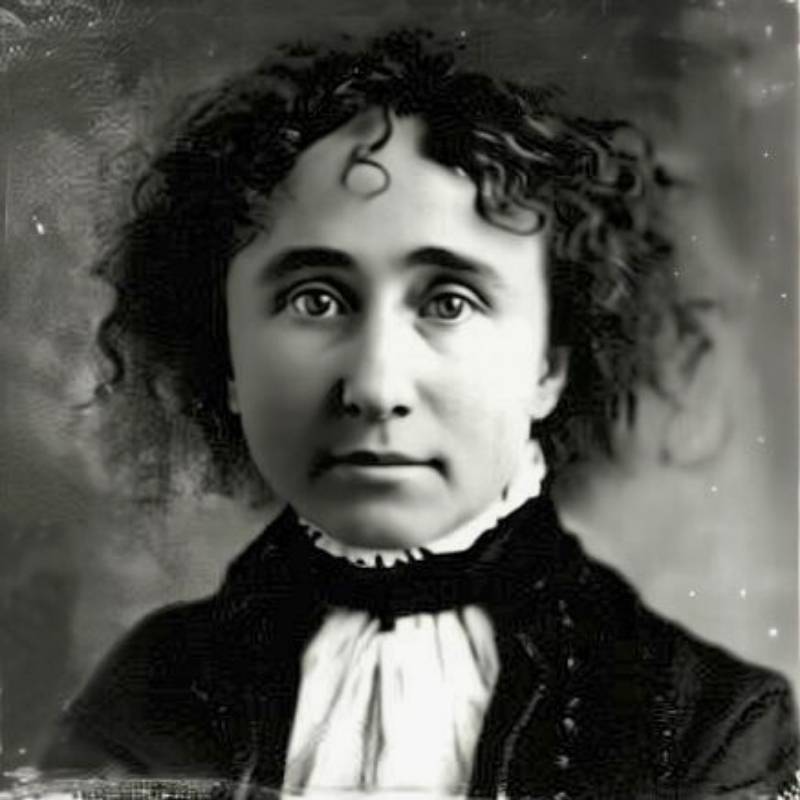
Born in 1877 in Berlin, young Gabriele took her first steps into the art world at a time when being a woman and an artist was almost tantamount to witchcraft. But our budding magician was not the type to be locked in the ivory tower of social conventions.
"Every artist dips his brush in his own soul, and paints his own nature into his pictures." — Henry Ward Beecher
This quote could have been Münter's secret grimoire. For that is precisely what she did throughout her career: paint with the very essence of her soul, creating abstract works of spellbinding emotional power.
The Alchemical Encounter: Münter and Kandinsky

In 1902, fate knocked on Gabriele Münter's door in the form of Wassily Kandinsky. It was the beginning of an explosive artistic collaboration and a complex love affair. Contrary to what might be assumed, Münter and Kandinsky were never married. They were companions for over a decade, living together without marrying — a bold act for the time!
Their personal and artistic relationship was intense and deep. Münter recalled: "Kandinsky opened my eyes to the magic of color. It was as if a veil had been lifted, revealing a world of infinite possibilities." Together, they explored new artistic dimensions, pushing the boundaries of figuration to venture into the still-unexplored realms of abstraction.
However, their relationship ended painfully. With the outbreak of World War I in 1914, Kandinsky, being Russian, was forced to leave Germany. Despite promises to reunite, he eventually married Nina Andreievskaya in Russia, leaving Münter devastated but determined to forge her own artistic path.
The Blue Rider: When Art Rides Among the Stars

In 1911, Münter and Kandinsky, joined by Franz Marc and other avant-garde artists, founded the group Der Blaue Reiter. It was a bit like the Avengers of modern art deciding to form a league of superheroes to save the world from painterly banality!
Their mission? To infuse a new expressiveness into painting, freeing color and form from the chains of realistic representation. Münter played a crucial role in this movement, bringing her unique touch of feminine magic to an art world dominated by men.
The Münter Style: A Spell of Colors and Emotions

Gabriele Münter's style is like a visual spell that captures the very essence of what she observes. Imagine a kaleidoscope of emotions projected onto canvas, and you'll have some idea of the bewitching power of her works!
Her paintings are characterized by:
- Bold colors applied in large flat areas, like chromatic spells
- Simplified yet expressive forms that capture the soul of her subjects
- Strong black outlines that structure the composition, like visual incantations
- A reduced perspective that emphasizes emotion over physical reality
Take, for example, her work "Stillleben mit Heiligem Georg" (1911). In this still life, Münter transforms everyday objects into a festival of vibrant colors. The blazing red of the background contrasts magnificently with the blues and greens of the objects, creating a hypnotic visual tension. It's as if she had captured the spiritual essence of the objects rather than their mere appearance.
The Legacy of an Art Sorceress

Despite the challenges posed by two World Wars and the rise of Nazism (which labeled her art as "degenerate" — what a compliment, coming from them!), Gabriele Münter pursued her artistic quest with the determination of a fairy-tale heroine.
Not only did she create a remarkable body of work, but she also played a crucial role in preserving the works of the Blue Rider during World War II. Acting as a guardian of artistic treasures, she hid and saved numerous works from Nazi destruction.
Today, her magical legacy is celebrated in prestigious museums:
- The Lenbachhaus in Munich, a veritable treasure trove of the Blue Rider
- The Centre Pompidou in Paris, where her works stand alongside those of the greatest modern masters
- The Solomon R. Guggenheim Museum in New York, a temple of modern art where her work continues to enchant visitors
A Colorful and Inspiring Legacy

Gabriele Münter was not merely a talented artist — she was a true magician who transformed the way we perceive art. Her courage, her vision, and her determination helped shape the face of modern art as we know it today.
So the next time you find yourself before a canvas of vibrant colors and bold forms, think of Gabriele Münter. Think of this woman who dared to defy convention, who painted with her heart as much as with her hands, and who left us a legacy of breathtaking beauty and magical expressiveness.
And who knows? Perhaps her bold, revolutionary spirit will inspire you to leave your own colorful mark on the world. After all, as Münter herself put it: "Art is a form of magic compatible with science." So, dear apprentice sorcerers of art, to your wands… I mean, to your brushes — and may the artistic revolution continue!