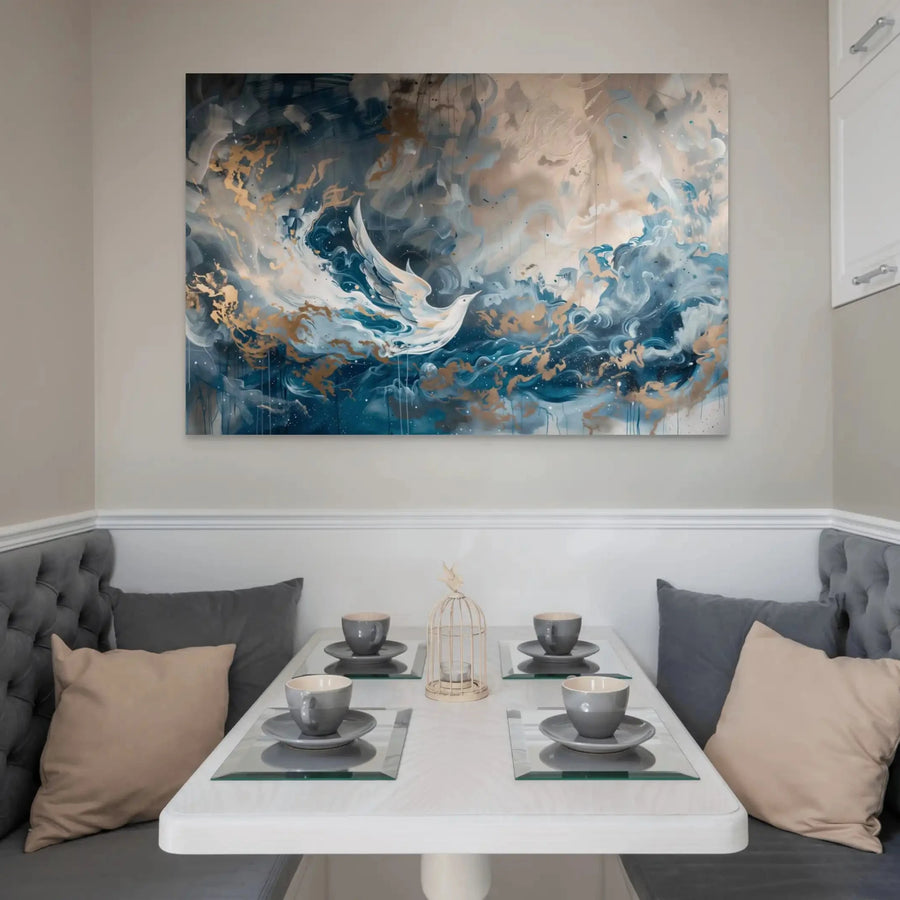
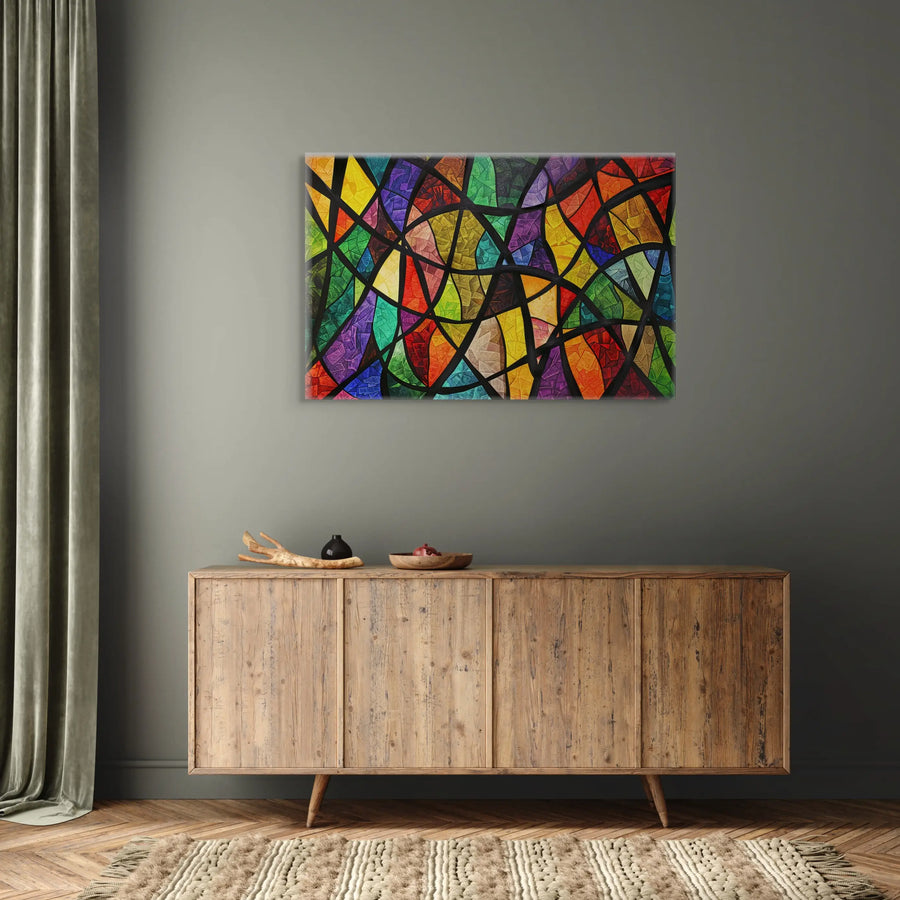

Abstract Painting: 5 Styles and How to Choose Wall Art
Do your walls feel unresolved rather than truly finished? Abstract art can give a room rhythm, depth and a focal point without dictating a single story. This guide explains five useful visual families, then shows how to choose a work that fits the proportions, colours and atmosphere of your interior.
A Curated Starting Point
Start with an evergreen selection rather than a short-lived trend: compare restrained geometry, fluid gestures and organic forms, then notice which visual tempo feels right in your space.
What is abstract painting?

At its broadest, abstract painting loosens or abandons the obligation to reproduce visible reality. Colour, line, shape, texture and scale become subjects in their own right. The history is not the work of a single inventor: Hilma af Klint was producing ambitious non-objective cycles from 1906, while Wassily Kandinsky later developed an influential theory of abstraction. Their aims and contexts differed, which is more revealing than a race to identify one “first” abstract picture.
A figurative work may still simplify or distort reality, whereas a fully non-objective painting need not begin with a recognisable person, landscape or object at all. Between those poles lies a wide continuum. The viewer therefore pays closer attention to relationships: a sharp diagonal against a calm field, a dense passage beside an open one, or a colour that changes as its neighbours change.
Five useful ways to read abstract painting
Abstract art is not a single movement. The five families below form a practical viewing guide, not an exhaustive or universally accepted taxonomy. Artists frequently cross their borders, and one painting may combine geometric structure, gestural marks and organic shapes. Use the categories to sharpen your eye, then allow the individual work to resist the label.
1. Geometric abstraction: order, rhythm and proportion

Geometric abstraction builds with measured shapes, intervals and alignments. In our guide to geometric abstraction, the square, circle and grid are not merely motifs: their spacing, repetition and imbalance create tension or calm across the canvas.
Key characteristics
- Pure or simplified geometric shapes: squares, rectangles, circles and grids
- Measured intervals, alignments and proportions
- A restricted palette or deliberate relationships between primary and neutral colours
Piet Mondrian demonstrates how few elements can sustain remarkable complexity. His grids are not mechanical templates; widths, placements and colour areas are carefully adjusted so that the surface feels balanced yet alive. This legacy continues in graphic design, architecture and interiors, where strong geometry can organise a visually busy room.
2. Abstract Expressionism: gesture and fields of colour

Abstract Expressionism emerged around New York in the 1940s and 1950s, but it cannot be reduced to “raw emotion”. It encompasses markedly different practices: action painting foregrounds gesture and process, while colour-field painting uses broad chromatic areas to produce a slower, more enveloping encounter.
Techniques and characteristics
- Action painting: bodily gesture and process remain visible
- Colour-field painting: broad chromatic areas encourage sustained looking
- Frequently large formats that change the viewer’s physical relation to the work
- Pouring, staining, brushing, scraping and other materially distinct processes
Jackson Pollock made movement visible through poured and dripped paint, while Willem de Kooning repeatedly moved between abstraction and figuration. Kandinsky’s Composition VII of 1913 belongs to an earlier European history of abstraction; it is a major, highly prepared composition, not a simple starting gun for the later American movement.
Looking for more energy?
Gestural paintings and intense colours can energise a living room, hallway or creative workspace. The key is to give an active work enough visual breathing room rather than surrounding it with competing accents.
Discover colourful abstract wall art3. Lyrical abstraction: painting as visual cadence

Lyrical abstraction favours flowing marks, layered colour and a sense of visual cadence. The term covers different post-war contexts, especially in Europe, so it is best understood as an approach to movement and atmosphere rather than a rigid recipe.
Distinctive elements
- Fluid, organic marks and layered veils
- Harmonised or gradually shifting colour relationships
- Rhythms that feel calligraphic or musical without illustrating a score
Zao Wou-Ki and Hans Hartung show how calligraphic energy, scraping, veils and rapid strokes can create depth without describing a literal scene. In an interior, this kind of work can soften strict architecture while retaining enough movement to reward repeated looking.
4. Reduction and minimalist approaches

Minimalist and reductive approaches ask how little a painting needs in order to remain visually active. Empty space is not a void: it sets the pace, isolates a colour or makes a small shift in proportion more noticeable.
Core principles
- Reduction to a small number of active elements
- Restricted colour, often neutral or monochrome
- Close attention to spacing, edge and proportion
Kazimir Malevich is an essential precursor through Suprematism and works such as Black Square, first exhibited in 1915. Calling the painting “minimalist” would be anachronistic: its radical reduction helped open questions that later minimalist artists would revisit, but it belongs to its own avant-garde programme. In a room, contemporary reductive art works especially well where materials and light already carry much of the atmosphere.
5. Biomorphic abstraction: nature reimagined

Biomorphic abstraction transforms curves, cells, seeds, bodies and landscape rhythms into non-literal forms. The result can feel familiar without representing a specific plant or figure: recognition hovers at the edge of the image and keeps the eye moving.
Key characteristics
- Curves and shapes prompted by bodies, cells, plants or landscapes
- Undulating lines that suggest growth, water or wind
- Stylised organic motifs that remain open to interpretation
Joan Miró, often discussed alongside Surrealism, developed a vocabulary of signs and organic forms that continually shifts between suggestion and abstraction. These ideas remain visible across modern wall art and contemporary illustration.
How to choose abstract art for your interior
The right abstract wall art is not chosen by colour alone. Consider the wall’s proportions, the furniture below it, the viewing distance, the light and the amount of visual activity already present. A successful piece should feel connected to the room without disappearing into it.
Scale and dimensions
Measure the available wall and the furniture that anchors it. Above a sofa or sideboard, a work or grouped composition often feels convincing when it occupies roughly two thirds of the furniture width, with comfortable space around it. A narrow vertical format can lift a tight passage; a landscape or panoramic format can stretch a low wall. Treat these as starting points and verify the real dimensions before ordering.
Colour and harmony
Let the painting enter into conversation with the room. Two reliable approaches are tonal continuity, which repeats one or two existing hues, and controlled contrast, which introduces a deliberate focal colour. Also check temperature and value: a muted blue can be calmer than an electric one, while a black-and-white work may still feel highly dynamic through scale and line.
- Tonal continuity: repeat selected colours already present in the room
- Controlled contrast: introduce a focal hue without competing with every other object
Cool blues, soft greens and greys can support a quiet mood; terracotta, orange and red tend to feel warmer and more immediate. These are tendencies, not psychological laws. Test the image beside your actual textiles, wood tones and daylight before deciding.
Choosing by room
| Room | Promising direction | Atmosphere to test |
|---|---|---|
| Living room | Gestural or colourful abstraction | Energy and a focal point |
| Bedroom | Lyrical or reductive work | Quiet rhythm and visual space |
| Office | Geometric abstraction | Structure and concentration |
| Entrance | Biomorphic or vertical composition | Welcome and personality |
| Dining area | Wide format or measured colour contrast | Connection and presence |
Three abstract works to explore
The following works illustrate three distinct directions: earthy geometry, high-contrast reduction and expansive colour. Product pages provide the current sizes and specifications; the labels below deliberately avoid embedding a price that may vary by market or format.

Terracotta Abstract Wall Art
Available in several sizes

Black and Gold Abstract Wall Art
Available in several sizes

Modern Colourful Abstract Wall Art
Available in several sizes
Explore the full abstract art collection
How to look at abstract painting

A useful way to approach an abstract painting is to postpone the question “What is it?” and begin with “What is happening?” Follow the direction of the marks, the distribution of visual weight, the edges, the repetitions and the places where your eye slows down.
- Spend enough time for your first impression to change
- Describe what you see before searching for a subject
- Notice your emotional response without treating it as the only meaning
- Study colour, edge, texture, scale and composition
- Read about the artist, date and original context
Abstract art invites personal response, but interpretation is not arbitrary. Your experience meets the artist’s materials, decisions and historical context. Two viewers may respond differently while still grounding their reading in what the work actually does.
Techniques and materials in abstract painting
The same abstract idea changes dramatically with the medium. Our guide to painting techniques compares oil, acrylic, watercolour, glazing and impasto so that you can distinguish effects created by the material from those created by the gesture.

Abstract artists work with brushes, knives, rollers, poured paint, collage and many other tools. Acrylic permits rapid layering; oil extends blending time; watercolour makes transparency and reserve central; mixed media can bring the physical surface into the composition. The choice is never neutral: it affects tempo, edge and depth.
| Technique | Common materials | Typical visual effect |
|---|---|---|
| Gestural painting | Oil, acrylic, enamel | Movement and visible process |
| Glazing | Oil or acrylic medium | Depth and transparency |
| Collage | Paper, fabric, printed matter | Texture and interruption |
| Mixed media | Ink, pastel, resin or found material | Layering and material contrast |
| Watercolour | Diluted pigments and watercolour paper | Lightness and reserve |
Unconventional materials can be equally important, but novelty alone does not make a work coherent. Experiment becomes meaningful when texture, support and colour serve the same visual intention. Our broader introduction to abstract art places these material choices within the movement’s longer development.
Landmarks in the history of abstract painting
No short list can summarise the history of abstraction, but the works below provide useful points of comparison across spiritual, geometric, gestural and colour-field approaches. Dates and labels matter because each painting responds to a different problem rather than advancing along one simple line of progress.
- Composition VII (1913), Kandinsky — a densely orchestrated early abstract painting whose preparation and layered motifs resist the myth of pure spontaneity
- Black Square (first exhibited 1915) by Malevich — a defining Suprematist work that radically reframed the relation between form and ground
- Composition with Red, Blue and Yellow by Mondrian — one of the best-known examples of the dynamic asymmetry of Neo-Plasticism
- Number 1A, 1948 by Pollock — an all-over field in which poured paint records movement across the surface
- No. 61 (Rust and Blue) by Mark Rothko — a colour-field painting whose scale and soft edges reward slow viewing
Together these landmarks show that abstraction can be analytical, bodily, meditative or symbolic. Looking at their differences is more useful than searching for a single definition that fits every canvas.
How to begin an abstract painting
You do not need academic drawing skills to begin, but freedom is not the same as randomness. A limited palette, a clear visual constraint and time spent observing each stage will usually produce a stronger painting than adding marks without pause.
Basic materials
- A primed canvas or heavy painting paper in a manageable size
- Acrylic paint for quick drying and water cleanup
- Several brush sizes, a painting knife and an optional roller
- An apron, gloves when appropriate and a protected, ventilated work area
First steps
- Limit the first palette to three to five colours
- Establish a ground so that bare white does not make every decision for you
- Build layers and vary opaque, transparent, sharp and soft passages
- Pause, rotate the work and decide whether an accident strengthens the composition
Classes can help you understand materials and safe studio practice, yet a small home exercise is enough to start. Photograph intermediate states, rotate the canvas and stop before every area has the same density. Learning when to leave a passage open is part of composition.
Where to continue your exploration
Continue by comparing works in person whenever possible. Scale, surface and colour are difficult to judge from a screen, and the best education often comes from moving closer to inspect the paint and stepping back to feel the whole composition.
- Visit museums and galleries to experience scale and surface directly
- Take a workshop to understand materials and methods
- Read artists’ writings alongside current museum scholarship
- Compare geometric, gestural, lyrical and digital practices
- Experiment with acrylic, watercolour, collage and mixed media
Abstraction: an open visual language

Abstract painting can cross languages, but it is not culturally neutral or understood identically everywhere. Its forms travel through specific histories, materials and viewing traditions. That combination of openness and context is precisely what makes it so rewarding.
There is no single correct emotional response. Give the work time, notice how your attention moves, then learn about its maker and moment. If you are choosing art for your home, browse our abstract wall art collection with both the visual experience and the real dimensions of your wall in mind.
Frequently asked questions about abstract painting
What are the five traditional genres of painting?
European academies traditionally ranked history painting, portraiture, genre scenes, landscape and still life. These are subject-based genres, whereas abstraction describes a way of organising or departing from representation. It is therefore misleading to present abstract painting simply as a “sixth genre”; it changes the terms by which a painting can be classified.
How do you build a strong abstract composition?
Begin with visual hierarchy: decide which area should attract attention first, then balance dense and open passages around it. Repetition can create rhythm, while a change in scale or direction can interrupt it. The rule of thirds is one option, not a law. Make small studies, check the work from a distance and remove elements that do not support the whole.
What is the difference between abstract painting and modern art?
Modern art usually names a historical field extending from the late nineteenth century through much of the twentieth; it includes both figurative and abstract movements. Abstract painting describes an approach that may belong to modern or contemporary art. Therefore not all modern art is abstract, and not all abstract painting is historically modern.
Sources and further reading
- Wassily Kandinsky, Concerning the Spiritual in Art.
- Mark Rothko, The Artist’s Reality.
- MoMA, resources on Abstract Expressionism and its materials.
- Solomon R. Guggenheim Museum, resources on Kandinsky, Hilma af Klint and Malevich.
- Anna Moszynska, Abstract Art, Thames & Hudson.
1 comment
Merci pour le partage de ces pertinentes informations sur l’art abstrait!