


Symbolism: Understand the Art Movement in 3 Minutes
Symbolist painting asks a deceptively simple question: what if a picture could make an idea, a fear or a desire visible without illustrating it literally? From the 1880s onwards, artists across Europe turned away from the claim that art should simply record the observable world. Dreams, myths, memory and spiritual unease offered a different kind of subject. Symbolism was never a single school with one technique. It was a constellation of writers and artists who shared a preference for suggestion over description—and for images that continue to unfold after the first glance.
 A universal, text-free visual bridge to the Art Nouveau collection.
Symbolism in painting: a clear definition

Symbolism emerged first as a literary label in France. Jean Moréas published the Symbolist Manifesto in Le Figaro in 1886, defending an art of ideas rather than objective description. Painters associated with the movement likewise sought forms for states that could not be measured: longing, dread, revelation, memory and desire. A symbol in this context is not a rebus with one fixed answer. It is an image—a flower, a mirror, a night landscape, a mythic figure—that opens several possible meanings through colour, rhythm and atmosphere.
Why Symbolism unsettled late-19th-century art

Symbolism developed in an age shaped by industrial growth, scientific confidence and the authority of naturalism. Its artists did not all reject modern life, but they resisted the idea that visible facts were the only legitimate subject of art. The inner world mattered just as much. A painting could therefore be emotionally exact without being optically realistic.
This shift also helps explain Symbolism's proximity to the decorative arts and Art Nouveau. Both valued expressive line, stylisation and the unity of an image. Yet the terms are not interchangeable: Art Nouveau is closely tied to design and ornament, while Symbolism is defined above all by its concern with ideas, psychic states and the invisible.
Four artists who reveal the movement's range

No short list can contain such a dispersed movement, but four painters provide useful points of entry:
- Gustave Moreau built densely worked scenes from biblical and classical myths. In works such as Oedipus and the Sphinx, jewel-like surfaces turn narrative into an encounter between knowledge, desire and danger.
- Odilon Redon moved from the charcoal blacks of his strange floating eyes and hybrid creatures to radiant pastels and oils. His images rarely explain themselves; they make imagination feel like a material presence.
- Pierre Puvis de Chavannes used pale colour, simplified bodies and measured space in monumental murals. Their silence and suspension influenced artists far beyond France, even when they rejected his public, classical scale.
- Edvard Munch transformed landscape and figure into carriers of anxiety, desire and isolation. He is not reducible to one movement, but his emotional compression made him central to Symbolism's northern history.
Recurring themes: dream, myth, desire and mortality

Symbolist subjects often return because they offer a language for experiences that resist direct description. Their meanings change from artist to artist and should not be reduced to a universal code.
- Dream and altered perception: impossible spaces, floating forms and uncertain scale loosen the ordinary rules of the visible world.
- Myth and the sacred: Orpheus, Salome, Oedipus, angels and saints allow personal and contemporary tensions to appear through inherited stories.
- Desire and the femme fatale: seductive women recur in fin-de-siècle imagery, but they also expose period anxieties about sexuality and gender. Looking critically matters more than repeating the stereotype.
- Melancholy and death: twilight, abandoned landscapes and fragile bodies give emotional form to loss, isolation and the limits of human knowledge.
- A living, mysterious nature: forests, flowers and water become active presences, charged with correspondences between the material and spiritual worlds.
How Symbolist painters built meaning

Symbolism has no single visual formula. Nevertheless, several recurring devices help us understand how these images work:
- Simplified or elongated forms distance the figure from everyday observation and give it the presence of an apparition or emblem.
- Expressive colour establishes an emotional climate rather than reproducing local colour faithfully.
- Repeated motifs—flowers, eyes, mirrors, masks or thresholds—create networks of meaning within an artist's work.
- Decorative line and flatness keep the viewer aware of the picture surface even when the subject suggests another world.
- Ambiguous space combines precise detail with haze, unusual perspective or improbable juxtapositions, leaving interpretation open.
Symbolism across Europe: connected, but never uniform
At the threshold between Symbolism and Expressionism, Munch made landscape register as an inner event. Our close reading of Edvard Munch's The Scream distinguishes its versions and shows why the central figure may be receiving the scream rather than producing it.

Symbolism circulated through exhibitions, journals, theatre, poetry and artist networks. Local traditions gave it markedly different accents:
- France: Moreau, Redon and Puvis de Chavannes established distinct models, while the Nabis explored the suggestive power of flat colour and decorative form.
- Belgium: Fernand Khnopff developed cool, inward portraits and James Ensor used masks and grotesque crowds. Their paths intersect Symbolism without becoming identical.
- Britain: Dante Gabriel Rossetti and Edward Burne-Jones belong to Pre-Raphaelite and Aesthetic traditions that preceded and fed later Symbolist taste.
- Northern Europe: Munch in Norway and Hugo Simberg in Finland joined familiar landscapes to loneliness, illness, folklore and death.
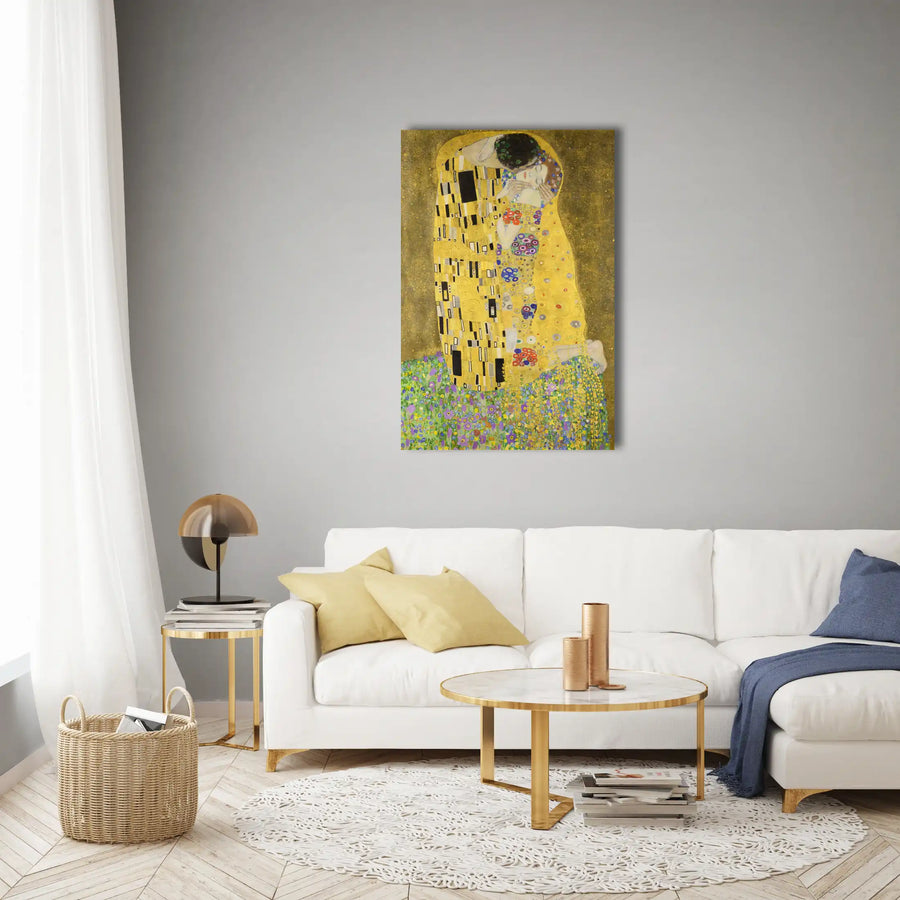
- Central Europe: Gustav Klimt and the Vienna Secession fused allegory, portraiture and ornament in a modern exhibition culture.
 A universal, text-free bridge to the Gustav Klimt collection.
What modern art inherited from Symbolism

Symbolism's legacy is best understood as a set of possibilities, not a family tree in which one movement mechanically produces the next.
- Surrealism renewed the investigation of dreams, desire and disturbing juxtapositions; Salvador Dalí transformed that inheritance through psychoanalysis and exacting illusionism.
- Expressionism intensified the use of distortion and colour to communicate psychic pressure rather than visible appearances.
- Abstraction shared the conviction that colour and form can carry meaning independently; Wassily Kandinsky gave that idea a particularly influential theory.
- Contemporary art continues to mobilise personal mythologies, ritual, archetype and ambiguous signs without necessarily adopting the historical Symbolist label.
How to look at a Symbolist painting

Begin with what the picture makes you feel before trying to decode it. Then ask how line, colour, scale and repetition produce that response. Identify any myth or familiar motif, but resist searching for a single dictionary definition. A mirror may suggest vanity in one painting, self-knowledge in another and an unstable boundary between worlds in a third.
The most rewarding Symbolist works keep evidence and uncertainty in balance. Historical context helps us recognise fin-de-siècle anxieties, religious references and literary connections; close looking prevents context from becoming a ready-made answer. The goal is not to solve the image, but to understand how it makes meaning remain active.
Further reading and viewing
- Read the Metropolitan Museum of Art's concise overview of Symbolism for its literary origins, artists and international reach.
- Use the Musée d'Orsay's route through the movements after Impressionism to place Symbolism among neighbouring experiments.
- Compare Redon's early charcoal drawings with the luminous flower pastels and oils of his later career.
- Read Huysmans's Against Nature alongside the visual culture of decadence, without treating the novel as a manifesto for every Symbolist painter.
- Trace the earlier elevation of emotion and imagination in our guide to Romantic painting.
Symbolism remains compelling because it trusts viewers to take part. Its images do not conceal one secret answer; they turn looking into a dialogue between the work, its history and our own inner world.