

The Kiss by Gustav Klimt: A Masterpiece of Love and Gold
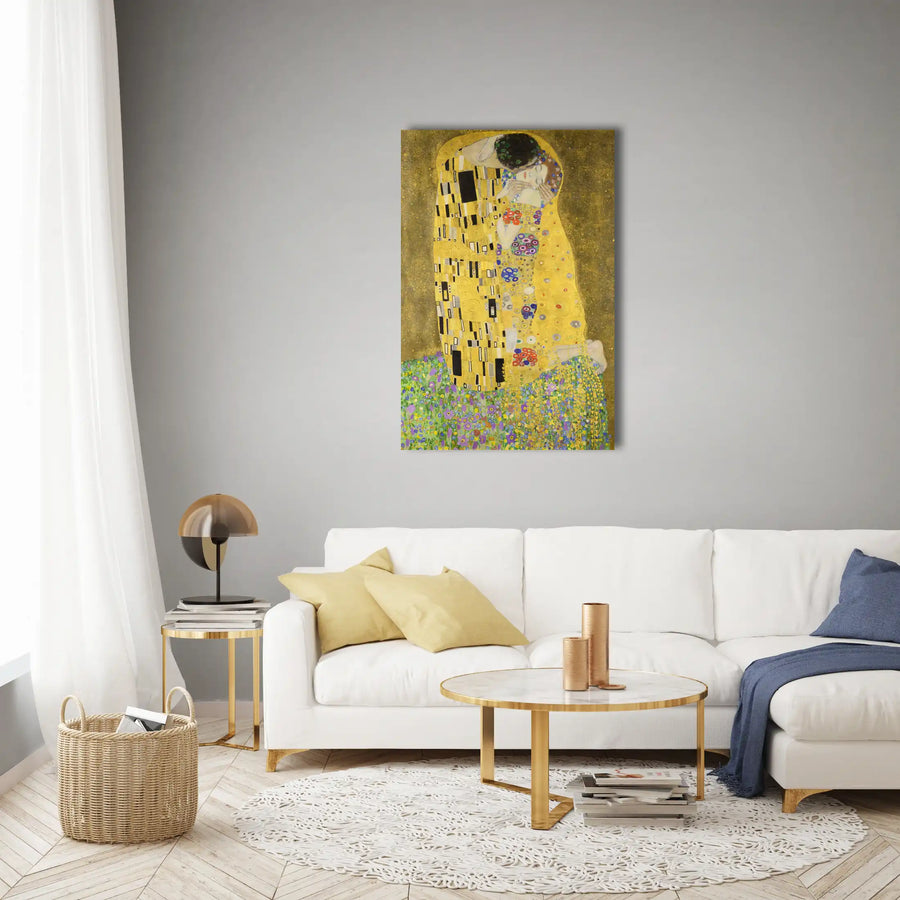
A couple stands at the edge of a flowered ground, wrapped in a field of gold. Their bodies are almost hidden by ornament, yet the small area of exposed faces and hands feels strikingly intimate. Gustav Klimt's The Kiss works through that tension: pattern brings the figures close to abstraction, while touch keeps the scene human. Painted in 1908/09, the square canvas belongs to Klimt's Golden Period and is now a highlight of Vienna's Belvedere. This guide looks closely at its materials, composition and historical setting—without turning its ambiguities into certainties.

The essentials in 30 seconds
The Kiss (Lovers) is a 180 × 180 cm painting dated 1908/09. Klimt combined oil paint with gold leaf, bronze paint and flakes of gold, silver and platinum. The Austrian state acquired it when it was first presented in 1908, and it remains in the Belvedere collection. Rectangles, spirals, flowers and circles organise the two robes, but their meanings are not a fixed code. The sitters have never been securely identified: the familiar idea that they are Klimt and Emilie Flöge is an attractive hypothesis, not a documented fact.
Five facts worth remembering
- A monumental square: at 180 × 180 cm, the format encloses the couple in a self-contained golden field.
- More than gold leaf: the Belvedere records oil, gold leaf, bronze paint and precious-metal flakes among the materials.
- An early public acquisition: the Austrian state bought the painting at its first presentation in 1908.
- An open identity: no surviving evidence establishes the two figures as portraits of Klimt and Emilie Flöge.
- A painting made to be seen slowly: distance reveals the icon-like silhouette; proximity reveals tiny differences in surface, colour and pattern.
Gustav Klimt and the Vienna Secession

Gustav Klimt was born near Vienna in 1862. His father was a gold engraver, but Klimt's command of ornament also came from formal training at Vienna's School of Arts and Crafts and from years spent producing decorative schemes with his brother Ernst and Franz Matsch. That background matters: in his mature paintings, surface decoration is not an accessory placed around the figure. It is one of the principal ways the picture thinks.
In 1897, Klimt became the first president of the Vienna Secession, the artists' association formed by members who broke with the conservative Künstlerhaus. The group sought greater freedom for contemporary art and created new exhibition spaces for painting, design and architecture. Klimt did not simply represent an Austrian version of French Art Nouveau; his work grew from the particular visual culture of Vienna around 1900, where Symbolism, applied arts and modern exhibition design met.
 Universal text-free visual previously validated and uploaded.
Explore our Gustav Klimt collection to compare the different ways he used gold, portraiture and decorative rhythm.
When and why was The Kiss painted?
Klimt produced the painting during the phase commonly called his Golden Period. Visits to Ravenna in 1903 exposed him to Byzantine mosaics whose luminous grounds dissolve ordinary space, although his interest in precious surfaces had several sources: his training, Japanese prints, medieval metalwork and the decorative ambitions of Viennese modernism all formed part of the picture. It is therefore more accurate to speak of a convergence than of one sudden revelation.
The work was shown in the 1908 Kunstschau, a major exhibition organised around Klimt and his circle. The Austrian state acquired it there before it was fully completed, a striking sign of recognition after the controversy surrounding Klimt's earlier university paintings. The Belvedere dates the finished work 1908/09. That museum evidence is preferable to the loose 1907–1909 date often repeated online.

How the composition holds the couple together
The figures form a single upright mass against a broad golden ground. Klimt gives us no conventional room, horizon or narrative setting. Only a narrow bed of flowers and the uneven edge beneath the woman's feet suggest a place. The surrounding emptiness makes the embrace feel detached from ordinary time, but it also creates a slight instability: the couple appears secure within the gold and precarious at its lower edge.
Look at the direction of movement. The man's robe presses down and around the woman; his head bends, his hands frame her face. Her body curves away before returning through the arm around his neck. One hand receives his, the other rests against his shoulder. Her closed eyes can suggest absorption, calm or uncertainty. The painting does not settle the emotional balance for us, and that unresolved quality is part of its strength.
Gold, pattern and the boundary between body and ornament

From a distance, gold creates unity. Up close, it breaks into distinct systems. Black and white rectangles articulate the man's robe; circular and floral forms spread across the woman's garment; spirals and small coloured marks bind the two zones together. The exposed skin is modelled more softly, so faces, hands and feet emerge from the decorative field with a different kind of presence.
Some interpretations describe the angular motifs as masculine and the rounded motifs as feminine. The contrast is visible, but the gendered meaning should remain a reading rather than a rule. Klimt also lets the patterns overlap. The two visual languages meet, echo and interrupt one another, which makes the embrace more complex than a diagram of opposites.
What does the flowered edge mean?
The lower edge is one of the painting's most suggestive passages. Flowers create a dense, sensuous ground, while the space beyond it has no depth. It can look like a meadow, a carpet, a stage or the brink of an abyss. None of these descriptions is a confirmed iconographic key. The important point is what the ambiguity does: it holds tenderness and danger in the same visual field.
That tension also prevents the gold from becoming merely luxurious. Gold flattens space and lifts the couple away from everyday life, but the woman's bare feet return the image to touch, weight and vulnerability. Sacred and sensual registers coexist without collapsing into a single message.
Who are the lovers?

The painting's fame has encouraged viewers to search for a biographical key. Klimt and the fashion designer Emilie Flöge are often proposed as the couple, and their lifelong closeness makes the idea tempting. Yet no document or secure likeness proves the identification. Other names have also been suggested. The responsible conclusion is simple: the models are unknown.
This uncertainty need not weaken the work. Klimt gives the figures enough individuality to make the embrace specific, then lets ornament move them towards an emblem. The result can be read as a private encounter and as a broader image of intimacy. Compare that openness with the sharper psychological drama of Klimt's Judith II.
Symbolism, Jugendstil and modern Vienna
The Kiss sits at the intersection of several labels. Its flattened ornament and designed surface connect it to Viennese Jugendstil and the decorative arts. Its suspended setting and concentration on desire connect it to Symbolism. Its exhibition history belongs to the Vienna Secession. None of those categories describes the whole painting on its own.
It is equally useful to notice what Klimt did not do. He did not abandon the body for pure ornament, nor did he use gold to imitate a medieval icon. Naturalistic faces and hands remain active inside a radically modern surface. The power of the image comes from that negotiation between representation and design.
Hands, faces and the choreography of touch
The most descriptive parts of the painting occupy very little space. Klimt concentrates attention on five zones: the man's profile, the woman's face, his two hands, her raised hand and the feet at the bottom. Their pale tones interrupt the metallic surface. This economy makes every contact count. His left hand supports her cheek without covering it; his right hand reaches around her head; her fingers fold over his hand rather than disappearing beneath it.
The woman's face is particularly controlled. A dark contour defines the eyebrow and closed eye, a small area of red marks the lips, and the turned neck establishes a diagonal against the vertical mass of the robes. Instead of illustrating a sequence—approach, kiss, response—Klimt compresses several moments into one pose. The viewer can read tenderness, surrender, hesitation or staged ritual because the gestures are precise while the narrative remains incomplete.
Love, intimacy and the limits of a universal reading
The Kiss is often presented as a universal image of romantic love. Its directness supports that reading: two figures, an embrace and a radiant enclosure can be understood without specialised knowledge. Yet “universal” should not erase the picture's historical and bodily particularities. The asymmetry of posture, the period's gender conventions and the transformation of the woman into a field of ornament all deserve attention alongside the tenderness.
A careful reading can hold those elements together. The picture neither supplies a simple ideal of equality nor reduces the scene to domination. It stages intimacy as a negotiation between closeness and separateness. The robes merge into a golden block, but the patterns remain distinct; the faces nearly meet, but each keeps its own direction. Klimt's lasting achievement is not a slogan about love. It is a visual structure in which union never completely cancels difference.
Influence and afterlife
The painting has become one of the most widely reproduced images of modern art. That popularity can make it seem familiar before we have really looked at it. Reproduction isolates the embracing couple and often intensifies the gold; the original, by contrast, depends on scale, material variation and the unstable relation between figure and edge.
Klimt's example mattered to younger Viennese artists, including Egon Schiele and Oskar Kokoschka, but their angular bodies and psychological pressure should not be treated as simple continuations of the Golden Period. The most useful legacy is broader: Klimt showed how portraiture, allegory and ornament could occupy the same modern picture. Our famous artists archive follows those different paths without forcing them into one lineage.
Seeing The Kiss at the Belvedere

The original belongs to the Belvedere and is normally displayed in the Upper Belvedere in Vienna. Because opening hours, gallery arrangements and ticket rules can change, check the museum's official visitor information before travelling. In the gallery, first step back far enough to see the compact silhouette; then move closer to compare the painted skin, metallic areas and small coloured motifs.
The collection also places Klimt among works by other Austrian modernists. That context is valuable: The Kiss is not an isolated romantic image but part of a period in which artists reconsidered the boundary between fine and applied art, private feeling and public display.
Technical record

- Title: The Kiss (Lovers); German: Der Kuss (Liebespaar)
- Artist: Gustav Klimt
- Date: 1908/09
- Materials: oil, gold leaf and bronze paint, with gold, silver and platinum flakes, on canvas
- Dimensions: 180 × 180 cm
- Inventory number: 912
- Collection: Belvedere, Vienna
- Context: Golden Period; Vienna Secession; Symbolism and Viennese Jugendstil
- Acquisition: purchased by the Austrian state at its first presentation in 1908
Look first at the whole golden silhouette, then at the hands and feet: the painting's meaning lives in the passage between ornament and touch.
Frequently asked questions
When did Klimt paint The Kiss?
The Belvedere dates the work 1908/09. It was first presented and acquired by the Austrian state in 1908, then completed in 1909.
How large is the painting?
It measures 180 × 180 cm. The square format gives the embracing figures a monumental yet enclosed presence.
Where can the original be seen?
It is in the Belvedere collection and is normally shown at the Upper Belvedere in Vienna. Consult the museum's official website for current access information.
Are the figures Gustav Klimt and Emilie Flöge?
Possibly, but the identification is not proven. The couple's identity remains undocumented, so it is better to present the Klimt–Flöge reading as a hypothesis.
Why did Klimt use gold?
Gold connected Klimt's interests in mosaic, metalwork, decorative design and non-naturalistic space. Ravenna's Byzantine mosaics were important, but they were one influence among several rather than a complete explanation.
Continue exploring Klimt and Vienna around 1900
- Read our guide to Gustav Klimt's life and major works.
- Place the painting within Art Nouveau and European design.
- Compare its open meanings with our introduction to Symbolism in painting.
- Browse the famous artists archive for Klimt's contemporaries and successors.