The Blue Rider: Revolution in Modern Art and Abstraction
Imagine a group of artists so far ahead of their time that they literally galloped art toward new horizons! This is the fascinating story of the Blue Rider (Der Blaue Reiter, for those with a taste for German), an artistic movement born in 1911 in Munich that shook the art world like a well-shaken cocktail. These artists didn't just change the way we perceive art — they flung wide the doors of a world of infinite possibilities in painting, profoundly influencing the development of modern and contemporary art.
The Brushstroke Masters Who Changed the Game

At the head of this artistic revolution, two geniuses who decided to make colors dance on canvas:
- Wassily Kandinsky (1866–1944): This Russian lawyer traded his legal robes for a painter's smock to become the father of abstract art. In his work "Concerning the Spiritual in Art" (1911), he wrote: "Color is the keyboard. The eye is the hammer. The soul is the piano with many strings." One delightful anecdote holds that Kandinsky had his artistic revelation when he saw a Monet painting… upside down! Proof, perhaps, that sometimes you really do need to look at things from a different angle. Art historian Will Grohmann notes in his biography "Wassily Kandinsky: Life and Work" (1958) that this experience led Kandinsky to explore "the emotional power of pure color and form."
- Franz Marc (1880–1916): This German painter had a gift for transforming animals into veritable fireworks of color. If Marc had painted Noah's Ark, it would have looked like a floating rainbow! In a letter to his wife, he declared: "I seek to intensify my sense of the organic rhythmic quality in all things, to develop a pantheistic empathy with the vibrating and flowing of blood in nature, in trees, in animals, in the air." Marc was so passionate about animals that he even studied animal anatomy to paint them better. Klaus Lankheit, in his "Franz Marc: Catalogue Raisonné" (1970), highlights that this approach allowed Marc to "transcend simple representation to achieve a spiritual expression of nature."
But this dynamic duo was not alone. They were joined by a merry band of artists, each bringing a unique touch to the movement:
- August Macke (1887–1914), the master of urban scenes who made cities look as if they were in a permanent state of celebration
- Paul Klee (1879–1940), the poet of the paintbrush who turned lines and dots into genuine visual symphonies
- Gabriele Münter (1877–1962), the pioneer who proved that women had every right to have their say (or rather, their brushstroke) in modern art
Art According to the Blue Rider: A Fireworks Display of Creativity

The Blue Rider was a bit like art deciding to have its rebellious adolescent phase. Out with the strict, boring rules — in with free, unbridled expression! Here is their secret recipe:
- Take vivid colors and mix them as if your life depended on it
- Add a generous dose of abstraction, as if you were painting your wildest dreams
- Sprinkle in some spirituality, because art is good for the soul
- And above all, forget everything you were taught in art school!
Kandinsky spoke of "inner necessity," as if every artist had a small conductor inside their heart dictating what to paint. It's a bit like your artistic intuition taking the wheel and driving you on a creative road trip!
Take for example Composition VII (1913) by Kandinsky, considered his pre-war masterpiece. It is an explosion of forms and colors that looks like what you might see if you put your dreams in a blender. According to art historian Will Grohmann, this work represents "the culmination of his research into pure form and abstract color" (Grohmann, 1958). Art critic Rose-Carol Washton Long adds in her work "Kandinsky: The Development of an Abstract Style" (1980) that this painting "marks a decisive turning point in Kandinsky's evolution toward pure abstraction."
"Art does not reproduce the visible; rather, it makes visible." — Paul Klee
This quote from Klee is a bit like saying that art is a pair of magic glasses that makes us see the world differently. Not bad, is it?
The Blue Rider Almanac: The Perfect Little Revolutionary's Handbook

In 1912, Kandinsky and Marc published the Blue Rider Almanac, a manifesto that hit the art world like a bombshell. It was like a travel guide for exploring the unknown territories of creativity. On the menu:
- Artistic theories that made your head spin (in a good way)
- A bold mix of ancient and modern art, like a grand masquerade ball where Picasso dances with Michelangelo
- Connections between painting, music, and theater, as if all the arts were invited to the same party
Art historian Rose-Carol Washton Long notes: "The Blue Rider Almanac played a crucial role in disseminating the group's ideas, establishing a dialogue between modern art and diverse artistic traditions — from Bavarian folk art to African tribal art." (Long, 1980) Professor Reinhard Zimmermann, in his work "Der Blaue Reiter in the Lenbachhaus Munich" (2016), adds that the Almanac "defined a new approach to art that transcended cultural and temporal boundaries."
The Blue Rider Exhibitions: When Modern Art Made Its Grand Entrance
The group organized two exhibitions that hit the art world like a tidal wave:
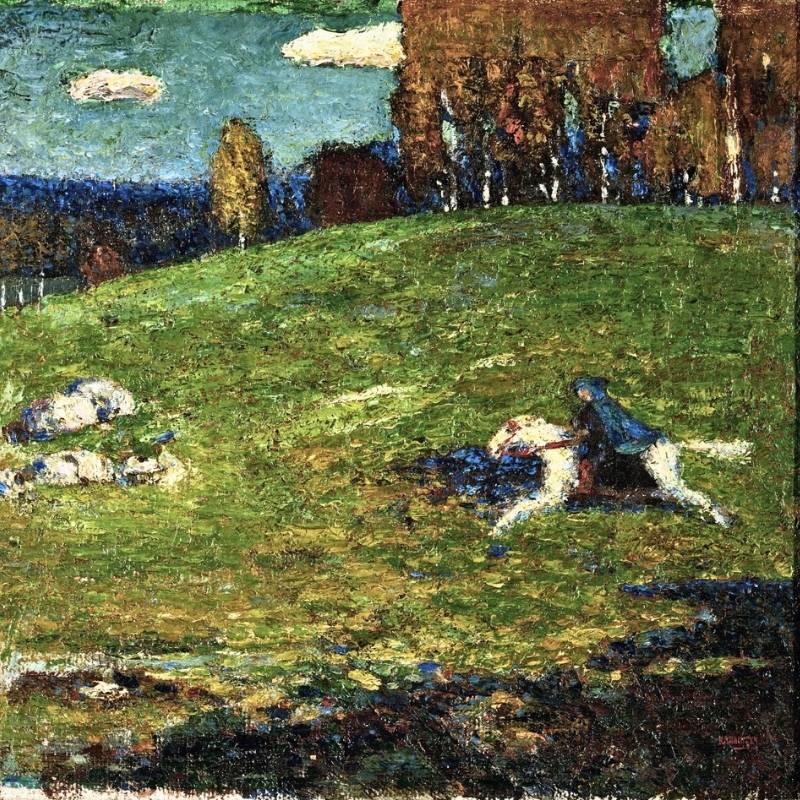
- The first, in December 1911 in Munich: imagine the shock of visitors accustomed to stiff portraits confronting these explosions of color! Some reportedly needed sunglasses to look at the paintings. Kandinsky's "The Blue Rider" (1911) was exhibited there, showing an abstract rider galloping toward a radiant artistic future.
- The second, in February 1912: this time, they invited international stars such as Picasso. It was like the Olympics of modern art! Franz Marc's "The Yellow Cow" (1911) was presented there — a dazzling vision of a bovine in impossible colors that seemed ready to leap off the canvas.
These exhibitions transformed Munich into a genuine capital of the artistic avant-garde. Watch out, Paris! Art critic Franz Roh noted: "These exhibitions marked a turning point in art history, presenting a radically new vision of what art could be and accomplish." (Roh, F. "Nach-Expressionismus," 1925) Art historian Shulamith Behr, in "Expressionism Reassessed" (1993), highlights that these exhibitions "catalyzed the development of abstract art in Europe."
The Legacy of the Blue Rider: A Rainbow Spanning Time

Even though the group existed for only a few years (thanks a lot, World War I…), its impact on art proved as lasting as a paint stain on a white T-shirt:
- They paved the way for abstraction and abstract works, like explorers opening up a new artistic continent
- Their influence spread like a trail of colored powder, inspiring movements such as Abstract Expressionism
- Kandinsky's ideas continued to multiply their impact throughout the 20th century
Art historian Magdalena Dabrowski noted: "The Blue Rider laid the conceptual and aesthetic foundations of abstract art, profoundly influencing the development of modern and contemporary art." (Dabrowski, M. "Kandinsky: Compositions," 1995, MoMA) Professor Horst Waldemar Janson, in his reference work "History of Art" (2001), goes so far as to affirm that "the Blue Rider opened the way toward a new conception of art that continues to influence contemporary artists."
Where to Find the Blue Rider Today?

If you want to see with your own eyes the works that changed the course of art history, here is where to go:
- The Lenbachhaus in Munich: the Blue Rider's headquarters, home to the world's largest collection. You'll find Franz Marc's "The Tiger" (1912) there — a multicolored feline that looks ready to pounce off the canvas!
- The Centre Pompidou in Paris: a Kandinsky collection to make anyone envious, including "Yellow-Red-Blue" (1925), a visual symphony that will make you see life in Technicolor.
- The Solomon R. Guggenheim Museum in New York: to see how the Blue Rider crossed the Atlantic. Don't miss Kandinsky's "Small Pleasures" (1913), an explosion of forms and colors that just might put a smile on your face for the whole day.
These museums continue to keep the spirit of the Blue Rider alive, organizing exhibitions that draw crowds like magnets. For example, the "Kandinsky, Marc & Der Blaue Reiter" exhibition at the Fondation Beyeler in 2016–2017 attracted more than 150,000 visitors. Not bad for a movement that is over a century old! According to curator Ulf Küster, this exhibition demonstrated "the continuing relevance of the Blue Rider in contemporary artistic dialogue" (Exhibition catalogue, 2016).
Ultimately, the Blue Rider remains an inexhaustible source of inspiration for today's artists. It is as if these pioneers had opened a door onto a world of infinite artistic possibilities — and that door is still wide open. So, ready to take an artistic carousel ride with the Blue Rider? Who knows — you might just discover your own "inner necessity" and become the next Kandinsky… or at least learn to appreciate abstract art without looking lost in a labyrinth of color!
Footnotes (For the Curious and the Meticulous…)
- Grohmann, W. (1958). "Wassily Kandinsky: Life and Work." Harry N. Abrams.
- Lankheit, K. (1970). "Franz Marc: Catalogue Raisonné." Verlag M. DuMont Schauberg.
- Washton Long, R.C. (1980). "Kandinsky: The Development of an Abstract Style." Clarendon Press.
- Roh, F. (1925). "Nach-Expressionismus: Magischer Realismus: Probleme der neuesten europäischen Malerei." Klinkhardt & Biermann.
- Dabrowski, M. (1995). "Kandinsky: Compositions." Museum of Modern Art.
- Zimmermann, R. (2016). "Der Blaue Reiter in the Lenbachhaus Munich." Prestel.
- Behr, S. (1993). "Expressionism Reassessed." Manchester University Press.
- Janson, H.W. (2001). "History of Art." Cercle d'Art.
- Küster, U. (Ed.) (2016). "Kandinsky, Marc & Der Blaue Reiter." Fondation Beyeler / Hatje Cantz.
- Hoberg, A. & Friedel, H. (2000). "Der Blaue Reiter und das Neue Bild." Prestel.
- Vezin, A. & Vezin, L. (1991). "Kandinsky et le Cavalier Bleu." Pierre Terrail.
- Düchting, H. (2012). "Le Cavalier Bleu." Taschen.
- Macke, W. (Ed.) (1989). "August Macke: Briefe an Elisabeth und die Freunde." DuMont.
- Barnett, V.E. (1995). "Kandinsky: Water colors and Drawings." Guggenheim Museum Publications.
- Golding, J. (2000). "Paths to the Absolute: Mondrian, Malevich, Kandinsky, Pollock, Newman, Rothko, and Still." Thames & Hudson.